Saturday, February 19, 2022

February 2022


2021 OSCAR NOMINATIONS

      Considering the scarcity of quality Hollywood films in 2021, the Oscar nominations arrived as expected with a best picture lineup filled with movies that feature moments of inspiration but never jell into cohesive cinema.

     Best picture nominees “Belfast,” “Dune,” “Licorice Pizza,” “Nightmare Alley,” “King Richard” and “The Power of the Dog” made for much better trailers than full-length movies; even “Don’t Look Up,” which made my Top 10, doesn’t quite deliver on its initial promise.

      “West Side Story,” a remake of the 1961 Best Picture winner, is clearly the finest picture of the year and the strongest competition for Oscar front-runner “The Power of the Dog.”


       I’m surprised that Academy favorite Joel Coen didn’t receive more love for “The Tragedy of Macbeth,” but I was pleased that Denzel Washington scored a best actor nomination. I hardly expected nominations for favorite of mine, including “The French Dispatch,” “The Card Counter” and “Pig,” but I was taken aback that “Passing” and its actresses Tessa Thompson and Ruth Negga weren’t recognized. I suspect that its story of African American life wasn’t upbeat enough, with voters preferring “King Richard,” a predictably uplifting entertainment.  

      I have no real quarrel with the best actor and actress nominees, save the absence of Oscar Isaac for “Card Counter,” Nicolas Cage for “Pig,” Lady Gaga for “House of Gucci” and Jennifer Lawrence for “Don’t Look Up,” who gives her best performance since her Oscar-winning “Silver Linings Playbook.” A pleasant surprise—for someone who hasn’t kept up with the pre-Oscar predictions—was the inclusion of Andrew Garfield in “tick, tick…BOOM!” It’s the kind of small, little-seen film that rarely receives recognition. In the opposite camp is “Being the Ricardos,” that seemed to be too big to fail, a very ordinary film that scored three acting nominations.

     I assumed “The Lost Daughter” would be among the best picture nominees—it’s a better film than most of the nominees—but it was good to see its trio of look-alike actresses, Olivia Colman, Jessie Buckley (both playing Leda) and director Maggie Gyllenhaal for her screenplay, garner nominations.

    Among the supporting nods, Ciarán Hands’ revived my belief in the Academy Award system; this Irish actor has been doing amazing work for decades and was the best thing about “Belfast.” I’m not sure what the voters had against two previous winners, Jared Leto, who was hilarious in “House of Gucci,” and Mark Rylance, who stole “Don’t Look Up” from the bigger stars.

    The nominations for best picture, best director and best screenplay for “Drive My Car,” the cathartic story of a Japanese actor-director dealing with tragedy following the win by “Parasite” in 2019 confirms that Oscar voters are more in touch with critical approval than ever before. (If I included foreign-language films in my Top 10, it would be among the top 5.)

     One of the year’s most satisfying nominations was for “Summer of Soul,” the reclaimed concert film documenting an exuberant 1969 Harlem music festival. It may have been the most entertaining film of the year.

      Here’s my Top 10 thus far:

      1. West Side Story (Steven Spielberg)

      2. The French Dispatch (Wes Anderson)

      3. The Card Counter (Paul Schrader)

      4. Pig (Michael Sarnoski)

      5. The Tragedy of Macbeth (Joel Coen)

      6. The Lost Daughter (Maggie Gyllenhaal)

      7. Passing (Rebecca Hall)

      8. Don’t Look Up (Adam McKay)

      9. House of Gucci (Ridley Scott)

    10. tick, tick…BOOM! (Lin-Manuel Miranda)


DRIVE MY CAR (2021)

    Though it takes a long time to get there—interminable rides inside the main characters red Saab listening to a tape of Chekhov’s “Uncle Vanya”—this Japanese import unearths the deep-seeded anger, guilt and sadness of the protagonist and his driver.

    The best reviewed film of 2021, winning best picture honors from the National Society of Film Critics, the New York Film Critics Circle and the L.A. Film Critics, Ryûsuke Hamaguchi’s meticulously directed contemplation on how humans react to personal tragedy plays like a primer in the different between Eastern and Western people, or at least how they are presented in most motion pictures.

     In almost every American film, characters are too anxious to share their feelings (especially in this era of reality show confessions), rarely holding in for more than a few scenes their entire range of emotions. Hollywood movies, from the beginning, have hinged on characters confronting one another, be it with loud voices, tears or guns. Asian films, those not directly imitating the West, allow unhappy characters to brood, deflect and generally carry on as if nothing has happened, often without ever achieving resolve.

    Yusuke Kafuku (a relentlessly stoic Hidetoshi Nishijima) is a well-regarded stage actor married to Oto (Reika Kirishima), a television writer. While their marriage seems relatively happy, considering that they lost a child at a young age, secrets create a troubling undercurrent. For Yusuke, that intensifies when Oto dies unexpectedly.

    After this long introduction, Yusuke, two years later, is contracted to stage “Uncle Vanya” in Hiroshima—an unspoken but clearly potent symbol of those dealing with loss.

    The long scenes of table-reading rehearsals consume much of the film’s three-hour running time as Yusuke patiently guides his multilingual cast (actors speak in Japanese, Mandarin, Korean and, stretching the realm of diversity, Korean sign-language. The rehearsals do have an unspoken dynamic as Yusuke has cast in the lead a young, volatile TV actor who he knows had an affair with his late wife. 

    But the key relationship of the second half of the film involves Yusuke and a young woman, around the age that his daughter would have been, assigned to chauffer him during his six-week stay in Hiroshima.

   At the start, Misaki (a convincingly restrained Tôko Miura) is all business, but slowly—everything in this film moves slowly—they bond during the long drives from the theater to his hotel while he listens to the “Uncle Vanya” tape his wife recorded for him. A family unit of sorts is formed within the confides of the Saab.

  I don’t think it’s a great film, but in this extraordinarily weak year for movies, I understand why it has garnered so much critical attention. “Drive My Car” offers what American films rarely attempt: a quiet, understated examination of how people deal with tragedy and the way loss can bring us together.


BEING THE RICARDOS (2021)

    While it’s surprising that it took so long for a major motion picture to depict TV legends Lucille Ball and Desi Arnaz, I don’t think this is the film anyone wanted to see.

     Telescoping all the difficulties of this power couple into one week in 1952, during the second season of “I Love Lucy,” writer-director Aaron Sorkin, with his third and least successful work behind the camera, paints a harsh, uncompromising portrait of Lucy, someone who is hard to like even as her comic genius and whip-smart humor is shown in full flower. The film’s drama centers around the uproar at CBS after gossip columnist Walter Winchell mentions on his radio show that the biggest comedy star on TV is a communist. (In the late 1940s and throughout the ‘50s, even being accused of being a communist could end one’s career.)

     At the same time, she and Desi announce to the network and sponsor that Lucy is pregnant and they want to turn that into the focus of the show until she gives birth. (At the time, pregnancy wasn’t acknowledged on television, considered an inappropriate topic for families.)

    Meanwhile, the real-life marriage of the first couple of TV isn’t going well.

    Like so many bio-pics, even those that avoid the cradle-to-grave story arc, the Ricardos, despite the emphasis on their flaws, never rise above imitations.
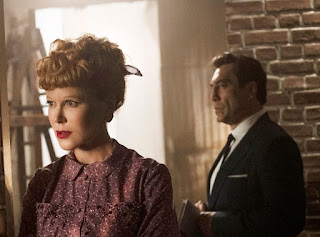

Nicole Kidman, made up with a smooth, shiny face I guess to “look” like Ball,” does an incredible imitation, both in her head and hand movements and her distinctive voice. But I’m not sure that was the best approach to the role.

    Undoubtedly, Sorkin and Kidman, knowing that Lucy has probably been seen and heard by more people than anyone in the history of filmed entertainment, felt  

they had to create a look-alike. Yet Javier Bardem as Desi, J.K. Simmons as Bill Frawley and Nina Arianda as Vivian Vance look nothing like their real-life counterparts and are just as effective. 

     The structure of the film seems disjointed to me in the way Sorkin has the writers and producer, shown years later and played by older actors, talking about the situation and leading into flashbacks of Ball’s film career and how she met Desi. (It’s sloppily researched also: among other things, they present Judy Holliday as a film rival to Lucy three years before Holliday made her debut.)

    While this isn’t legitimate criticism, what I really wanted to know and have always been curious about, is why CBS ever agreed to allow a Cuban-American to co-star in a show in 1951. At that point, Ball was a minor movie star and had no industry clout. The film offers no answer.

     For devotees of the show, the film shouldn’t be missed for its extensive rehearsal scenes, cast member interaction (even though it doesn’t go much beyond what has been talked about in the intervening years) and the moments that illustrate Lucy’s comedy acumen. For the rest of us, re-watching a couple of old episodes will suffice. 


TICK, TICK…BOOM! (2021)

     There’s something very appealing about seeing the creative process portrayed on screen—it’s rarely been done successfully. In this Lin-Manuel Miranda film, the story of “Rent” creator Jonathan Larson’s writing his earlier failure, “Superbia,” reveals more about what it takes to “make it” than any tale of success.

     The pop musical “Rent,” which took Broadway by storm in 1996, chronicles a collection of poor struggling artists (an updated “La Boheme”) in New York City as AIDs devastated the community. It went on to win the Pulitzer Prize and Best Musical Tony, running 12 years. Tragically, the 30-year-old Larson died of aortic dissection the night before its premiere.  

     This musical is also a Larson creation, written about his attempt to write “Superbia,” a futuristic musical, as his 30th birthday approaches (tick…tick) that was staged as a one-man show. Miranda and screenwriter Steven Levenson (“Dear Evan Hansen” and the TV miniseries “Fosse/Verdon”) turn it into a lively entertainment and an insightful look at young ambition, both Larson’s and anyone who has tried to express themselves in art.

    Andrew Garfield, best known as the 2012-14 Spiderman but who has given impressive performances in “The Social Network,” “Hacksaw Ridge” and most memorably in Martin Scorsese’s “Silence,” holds this crazy quilt of a movie together as it bounces from his day job at a diner, to long hours trying to write that one last song to actually performing at preview of “tick..tick.” I never would have imagined Garfield in the role, but he’s superb, well deserving of his Oscar nomination.

     The musical is filled with believable characters, not that common for musical adaptations, including Robin de Jesus as his best friend and Bradley Whitford as a supportive Stephen Sondheim, who agreed to hear a presentation of “Superbia.”

     As a teen, Miranda was inspired by “Rent” and his admiration for Larson is clear through the picture as is his love of the Broadway musical. In one of the film’s most memorable sequences, stage legends Chita Rivera, Bernadette Peters and Joel Grey, among many others, show up at the diner for “Sunday,” a lament about Larson’s waiter job and the glory of big production numbers. 

     For me, this was one of the real movie surprises of the year; I found “Rent” to be pretentious and dull at least in the road show version I saw 15 years ago and probably would not have watched “tick..tick” if it wasn’t available for streaming on Netflix. I ignored my expectations and saw one of the year’s most entertaining films.


DEADLINE AT DAWN (1946)

      Now all but forgotten, Harold Clurman was among the key architects of American theater during its creative height in the mid-20th Century. Among the founders of the Group Theater—an incubator for modern acting and playwriting—in the 1930s (with Lee Strasberg and Cheryl Crawford), he directed such landmark productions as Clifford Odets’ “Awake and Sing,” “Waiting for Lefty” and “Golden Boy;” Maxwell Anderson’s “Truckline Café,” which introduced the world to Marlon Brando in 1946; and later Broadway hits “The Member of the Wedding” and “Bus Stop.”

     Clurman and other Group Theater alumni, including his wife, legendary acting teacher Stella Adler, reinvented drama by introducing Method acting and putting the focus on characters’ internal struggles and motivations as part of a probing, psychological presentation of a playwright’s work.
  

Along with his stage work, he wrote extensively about the theater, off and on as a theater critic for The New Republic and The Nation.

     As the Method started to influence movie acting after World War II, Clurman dipped his toe into filmmaking, for the first and last time, directing this 1946 crime picture.

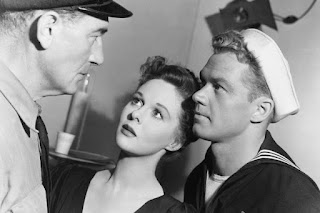
     Scripted by longtime collaborator Odets, from a novel by veteran crime writer Cornell Woolrich (“Rear Window”), “Deadline at Dawn” follows a late night-early morning journey through New York City’s underbelly by Alex, a wide-eyed innocent sailor (Bill Williams). After blacking out after a night of drinking, the Navy man on shore leave finds himself in possession of a wad of money given to him by a woman he finds dead.

     Fearing that he’s responsible, Alex enlists June, a cynical dance hall girl, played by Susan Hayward, and talkative cabbie Gus, superbly portrayed by Paul Lukas, fresh off his Oscar win for “Watch on the Rhine,” to help him track down who killed the girl, one step ahead of the mob and the cops.

     The smart script by Odets and noirish location cinematography by veteran Nick Musuraca (“Cat People,” “Out of the Past”) helps the movie overcome its clunky plot; clearly, the filmmakers were more interested in ideas and the movie’s menagerie of nighttime characters.

     Hayward’s performance is among her best, just before she became the ultimate Hollywood drama queen, racking up five Oscar nominations that culminated in her Oscar-winning turn as the prostitute sentenced to death in “I Want to Live” (1958).

     But Lukas gets the best lines and has the most interesting role in “Deadline at Dawn,” as he offers philosophical asides and street-wise wisdom to the innocent Alex. His (Odets’) best line: “Remember, speech was given to man to hide his thoughts.”


PARALLEL MOTHERS (2021)

     The plot of this Spanish film might have been lifted from a television soap opera yet director Pedro Almodóvar layers the film with thoughtful insight into human nature through his fully drawn characters and an overarching connection to the country’s tragic past.

     In a film overloaded with plot turns, Almodóvar’s muse of 25 years, Penélope Cruz, plays Janis, a magazine photographer who connects with Arturo (Israel Elejalde), a well-known archeologist, during a photo shoot. She’s hoping he can expedite a request to excavate an unmarked grave where her family believes her great-grandfather was buried by Fascists after he was executed during the 1930s civil war.

     The horrors of the past hang heavily over the film even as the plot turns toward personal problems. After giving birth as a result of an affair with Arturo, Janis begins to doubt the child’s paternity; a DNA test confirms that she isn’t the mother and most likely her child was switched with the newborn of a younger woman who she shared a room with in the hospital and gave birth on the same day.

   When Janis and the young woman, Ana (Milena Smit) reconnect, they end up living together and raising the child together. At the same time, Arturo keeps popping back into Janis’ life.

   In lesser hands this film would be a jumbled, cliché-filled throw-away, yet Almodóvar’s pointed dialogue and obvious sympathy for the women and their various dilemmas turn “Parallel Mothers” into a heartbreaking study of womanhood.

    Cruz gives one of her best performances as Janis, a careful, old-fashioned woman who guides the viewer through the complexities of life the director throws onto the screen. Smit matches the veteran actress in their emotional intense scenes together as does Aitana Sánchez-Gijón as Ana’s mother who prioritizes her acting career over being part of her daughter’s life. And, as in almost all recent Almodóvar films, Rossy de Palma is a presence as Janis’ best friend.

      Since the 1980s, the writer-director has been among the foremost filmmakers in the world, continuing to bring powerful, emotional, sometimes outlandish stories of modern women to the screen.   


THE GREEN KNIGHT (2021) and THE LAST DUEL (2021)

     I guess the 14th Century is where it’s at, as two major films, set on opposite side of the English Channel, were released last year. While Ridley Scott, one of Hollywood’s most accomplished directors, with three major stars, delivered a plodding “Duel,” the lesser-known David Lowrey (“The Old Man & the Gun”) works magic with a Middle Ages fantasy in “Green Knight.”        

      Beautifully photographed and directed, this offshoot on the Round Table legend based on a 14th Century epic poem tells of the journey by Gawain, a low-regarded nephew of King Arthur to pay his debt to the monstrous Green Knight.

    Gawain’s destiny is determined when an imposing knight rides into a Christmas gathering of Arthur’s court challenging anyone to swing their sword on him. The caveat of the challenge is that the challenger must endure the same blow from the Green Knight in a year’s time. Gawain, who has led a life of debauchery up until now, wants to prove himself to his uncle, the King. So he takes up the sword and foolishly beheads the monster, who promptly picks up his head and rides off reminding the young man that he’ll see him in a year.

      Impressively, he doesn’t dodge the challenge, determined to prove his worth and earned knighthood. In December, he sets off on the journey where he encounters real and ghostly obstacles.

     Dev Patel, who I’ve been underwhelmed by in the past (“Slumdog Millionaire,” “Lion”) shines as a man who is determined to rise above his natural tendencies even if it costs him his life. He makes you believe every fantastical trial he endures on his way to the Green Castle.

    Alicia Vikander, whose career seems to have stalled since she burst on the scene in 2015 with “Ex Machina” and “The Dutch Girl,” which earned her an Oscar, stands out as both of Gawain’s love interests, first as a local girl and then as a noble woman. Also memorably are Joel Edgerton as a mysterious hunter who lives near the Green Knight and Sarita Choudhury as Gawain mother who conjures up all sorts of strangeness.

    But the key to the film’s power is the vibrant look created by cinematographer Andrew Droz Palermo (“A Ghost Story”) and production designer Jade Healy (“I, Tonya” and “A Beautiful Day in the Neighborhood”).

      In “The Last Duel,” French knight Jean de Carrouges (Matt Damon sporting an awful mullet), a hot-headed ruffian, keeps getting undercut by his former best friend, Jacques Le Gris (Adam Driver), who steals part of his property and his title while eyeing his wife. While Jean lacks the sophistication (1380 version) to be part of the in-crowd, Jacques hangs out with the unsavory, hedonistic Pierre d’Alencon (a blond Ben Affleck), including participating in his orgies, earning protection from this high-ranking nobleman.

     In an attempt to present all side of the story, Scott tells the same story three times, from different perspectives. Unfortunately, only minor differences are revealed; too many scenes play out three times in almost duplicated form. I appreciated the subtlety, but at 2 and a half hours, the repetition grew tiresome. 

    The only reason to sit through the movie is for Jodie Comer’s moving performance as Marguerite, Jean’s wife. The star of the TV thriller “Killing Eve” (she won an Emmy for it), Comer also played Rey’s mother in the last “Star Wars” episode “The Rise of Skywalker” (2019). In “The Last Duel,” she creates a character with believable emotions, while the three male stars chew on the scenery.   


ON THE ROCKS (2020)

    I’ve not been impressed with Sofia Coppola’s directing career thus far, but her latest is clearly the most interesting film she’s made since “Lost in Translation” (2003). The reason is simple: she’s once again tapped into the genius of Bill Murray.

    Since the late 1970s, he’s made everything he’s been in better, from truly awful films (“Where the Buffalo Roam,” “Scrooged”) to comedy classics (“Tootsie,” “Caddyshack”). It’s long past the time to acknowledge that Murray, even as he plays the same character in almost every film, is among the finest comic actors in film history. He can make you laugh just by standing there or with a simple sideways glance.

    He’s in his element as Felix, the wealthy, martini-sipping playboy father of Laura (TV veteran Rashida Jones), who encourages her suspicions that her husband is cheating on her. I’m being charitable in saying the plot is flimsy, but when Felix starts turning his daughter’s marital problems into an adventure—he brings crackers and caviar when they spy on Dean (an unconvincing Marlon Wayans)—the picture comes alive. The scene in which he talks his way out of a traffic ticket is a classic Murray bit.

    At the heart of the film’s weakness is the lack of chemistry between Laura and Dean---it doesn’t even matter if he’s having an affair; the body language of the couple and their conversations make it clear that they aren’t meant for one another. But the movie tells me something else.

    But that’s easily put aside as you enjoy the manner in which Murray, so casual, seemingly unrehearsed, creates yet another comic gem.  


Photos:

 The community dance scene from “West Side Story.” (Twentieth Century Fox)

 Nicole Kidman and Javier Bardem in “Being the Ricardos.” (Amazon Studios)

 Paul Lukas, Susan Hayward and Bill Williams in “Deadline at Dawn.” (RKO Radio Pictures)

 Dev Patel on the road in “The Green Knight.”  (A24)


Friday, January 14, 2022

January 2022


LICORICE PIZZA (2021)

    Paul Thomas Anderson’s mash-up of his and his boyhood friend’s recollections of 1970s Southern California, filled with so many appealing moments, fails over and over again to turn those scenes into a coherent, emotionally meaningful movie. Like too many films in the last 20 years, “Licorice Pizza” works as great trailer but disappoints when it spools out over two hours.

    The movie opens with a cherry bomb going off in the boys’ restroom and a long tracking shot of self-assured child actor Gary Valentine making time with photographer’s assistant Alana Kane as he waits in line to have his yearbook photo taken. Gary, played by Philip Seymour Hoffman’s son Cooper, impresses the older girl (played by Alana Haim of the pop trio Haim, who Anderson has directed videos for) enough that she meets him at his regular hangout, the Studio City restaurant Tail o’ the Cock, a popular spot for Hollywood celebrities, and lesser lights, for decades before closing in the 1980s.      


    Not long after, Gary arranges for Alana to be his adult chaperone on a trip to New York to promote a movie he appeared in (Christine Ebersole plays a tough-talking, barely disguised Lucille Ball), but the truth is that his acting career has stalled. But this film isn’t interested in what Gary, an actor tossed aside by Hollywood, feels about his fate. Instead, he’s soon opening a waterbed store, a plotline that goes nowhere.

     Later, Alana volunteers for a candidate running for L.A. mayor and Gary opens a pinball arcade, more episodes that Anderson doesn’t even attempt to connect to the central story of the young couple.

     The two talked-about sequences that are responsible for the film’s mostly positive reviews center on real-life Hollywood figures, hair dresser turned producer Jon Peters and William Holden (called Jack here), one of the biggest midcentury movie stars.

     Holden (a spot-on performance by Sean Penn) is introduced when Alana auditions for “Breezy,” (a role played in the real film by Kay Lenz) a 1973 Holden movie. The 57-year-old actor makes a play for Alana and they end up at Tail o’ the Cock (where else?). It’s an amusing episode until Tom Waits shows up, playing a producer friend of Holden, who rants incoherently and then leads the restaurant patrons outside to watch Holden make a motorcycle jump.

     The episode featuring Peters (an outrageously over-the-top Bradley Cooper)—reportedly approved by the still-living producer—involves the delivery of a waterbed, Peters running out of gas in the midst of rationing and, like Holden, putting the moves on Alana. I’m not sure, but maybe the creepy old guys hitting on Alana helps to mitigate the idea that she’s a 25-year-old hanging out with high schoolers. Cooper’s best moment—seen prominently in the trailer—isn’t used (it does show up in the closing credits) and the overly long sequence ends without resolving what happens to Peters.

      The scenes also include a flamboyant assistant to Peters, whose portrayal is patently offensive. Though he’s not as bad as a restaurant owner, played by John Michael Higgins, who speaks to his Japanese wives in English with a Japanese dialect right out of a World War II movie. Both seem to be used for cheap laughs, not making any social point.

     In other words: the film is a hodgepodge of events that apparently happened to Anderson’s friend Gary Goetzman (now a producer in partnership with Tom Hanks), held together by the off-and-on relationship between Gary and Alana. It most reminded me of a Roger Corman film from that era, where the only glue to the craziness is the smart-ass high school student.

    Haim does her best to hold the film together, her screen presence for a newcomer is impressive, but Cooper Hoffman has zero acting skills, creating a huge void throughout the picture.  To say this is a long way from “Phantom Thread” or “There Will Be Blood,” both starring Daniel Day-Lewis, is an understatement. In some ways, it resembles Anderson failed hippie private eye film “Inherent Vice,” which also kept teasing viewers with amusing scenes.  

      Like Quentin Tarantino with “Once Upon a Time in Hollywood,” Anderson’s passion for his nostalgic milieu—the alluring fringe of the movie business—serves as a weak substitute for storytelling. “Licorice Pizza” offers an impeccable recreation of the era but has nothing to say about it.


PETER BOGDANOVICH  (1939-2022)

      Few filmmakers have managed, for better or worse, to entangle their personal lives with their profession to such an extent as Peter Bogdanovich, who died this month at the age of 82. Yet no matter how many times scandals or financial problems sent his film career spiraling, he re-emerged for yet another act in his bumpy ride of a life.

      Though he dropped out of high school, he found work writing about film for various magazines in the early 1960s, leading to the crucial gig of his early life: interviewing legendary filmmakers about their careers for a Museum of Modern Art film retrospective. After soaking in the knowledge of the masters—John Ford, Alfred Hitchcock, Howard Hawks and, most importantly, Orson Welles—and then serving a four-year stint in the Roger Corman company (as did Jack Nicholson, Francis Coppola and Martin Scorsese, among many others), Bogdanovich was primed for success by the end of the 1960s.

    His official directorial debut was for Corman on “Targets” (1968), an underrated gem about a psycho who goes on a shooting rampage that also features Boris Karloff as an aging movie star. During this period he also had a role in Welles unfinished film “Written on the Wind,” which Bogdanovich helped reconstruct and engineer its released in 2018.

     Then, at age 32, he directed the film he’ll forever be remembered for, “The Last Picture Show” (1971), based on Larry McMurtry’s novella. The movie earned eight Oscar nominations, including best picture and best director. This heartbreaking black-and-white tone poem about the death of small-town America hasn’t aged a bit and remains among the half-dozen finest Hollywood films made in the past 50 years.

     A hard act to follow, but Bogdanovich kept the box-office hits coming, with two comedies, “What’s Up, Doc?” (1972) with Barbra Streisand and “Paper Moon” (1973) with Ryan O’Neal and his young daughter Tatum. But the magic disappeared when he tried to elevate the career of his girlfriend Cybill Shepherd (he “discovered” her for “Last Picture Show”) with “Daisy Miller” (1974) and a musical “At Long Last Love” (1975), both of which bombed.

      Over the next 20 years, he directed two good films, “Saint Jack” (1979) starring Ben Gazzara as a Hong Kong hustler and “Texasville” (1990), a sequel to “The Last Picture Show,” with Jeff Bridges returning as Duane in a superb performance. But the key film for Bogdanovich in this period was “They All Laughed,” a 1981 comedy starring the director’s latest love, Playboy model Dorothy Stratten. Before the film was released her jealous husband shot her to death. (Her tragic story was the basis for Bob Fosse’s 1983 film “Star 80.”)

     When “They All Laughed” did poorly, Bogdanovich bought the film from the studio (an unheard-of move) and tried to release it himself. He later penned a book about Stratten that accused Playboy magazine’s Hugh Hefner as contributing to the woman’s death and then married Stratten’s younger sister. The scandal all but destroyed the director’s career.

     By the 1990s, he was making TV movies and struggling to stay financially afloat—at one point he was reportedly living in Quentin Tarantino’s guesthouse.

     But he kept remaking himself. In the new century, he took up the mantle of the spokesman for the great directors and films of the 20th Century (He published a collection of his interviews with those filmmakers in 1997, “Who the Devil Made It.”) His last film of note was “The Cat Meow” (2001), about the suspicious death of silent film producer Thomas Ince while aboard William Randolph Hearst yacht. It was a story right up Bogdanovich’s alley.

    Always elegantly dressed with his signature kerchief—a New Yorker profiled described him as looking like Thurston Howell III---the filmmaker never lost his smug, sardonic tone and never tired of discussing his friendship with Welles and others.

    While he wasn’t a great director and often a comical figure, Peter Bogdanovich did make one masterpiece and, just as valuable, remained the living link between modern Hollywood and those 20th Century giants that the industry was built upon.


THE LOST DAUGHTER (2021)

       Every time I came close to dismissing the film’s main character Leda as a spoiled curmudgeon, actress Olivia Colman (and Jessie Buckley as her younger self) brought out another aspect of this complex, unstable and fascinating woman.

      The actresses dominate this thinly plotted, sketch of a film, the directing debut of Maggie Gyllenhaal (“Sherrybaby,” “Crazy Heart”). We first are introduced to the 48-year-old version of Leda, a college professor, when she arrives at a sea-side cottage in Greece for a summer vacation and soon is forced to share the small beach with a large, boisterous American family. When the young daughter of the family gets lost, Leda’s connection to this rowdy, bickering group grows, but more importantly it brings back her memories of her own struggles as a young mother and her conflicting desires when she was in her 20s.

    As young Leda’s academic career flourishes, her interest in being a stay-at-home mother and homemaker withers. And almost 30 years later, she is still grappling with the decisions she made. Which may, or may not, explain some of the odd behavior displayed by this seemingly stable teacher.

     While Colman, who won an Oscar playing an unstable 18th Century queen in “The Favourite” in 2018, and Buckley, memorable as the unhappy fiancé in “I’m Thinking of Ending Things,” are the movie’s focus, the supporting cast is just as interesting. The always distinctive Ed Harris plays the caretaker of the rental, Dakota Johnson is the young mother who mirrors Leda’s youth, Paul Mescal plays a college student working at the resort and Peter Sarsgaard portrays a self-assured professor who meets young Leda at a conference.

     Based on a novel by acclaimed Italian writer Elena Ferrante, the film explores motherhood in complexities rarely seen on screen, where mothers are typically saints or sinners, but offers more questions than answers about this conflicted woman.     


TWENTY PLUS TWO (1961)

      This low-budget, well-plotted black-and-white crime film starring TV star David Janssen, a picture that was seen by virtually nobody when it was released and has been nearly unseen since, would make my Top 10 if it was a 2021 movie.

     For Janssen, who had just finished a four-year run as “Richard Diamond, Private Eye” and was two years away from “The Fugitive,” “Twenty Plus Two” was among his first starring film roles. Oddly, he doesn’t play a detective but a specialist who seeks out missing persons who have inherited money.

     Tom Alder’s interest in a 12-year-old case is revived when the murdered secretary of a movie star’s fan club has a collection of clips about the missing girl. He tracks down the star, Leroy Dane (a miscast Brad Dexter), but also runs into Linda, an old girlfriend (Jeanne Crain) and her friend Nicki (Dina Merrill). Soon Tom is jetting around the country in search of clues and keeps running into Dane, Linda and Nicki.

      Shot like a TV series (with way too many shots of airplanes taking off and landing) and directed with little style by Joseph M. Newman, a longtime second unit director who made dozens of B-movies in the 1950s and ‘60s, the film comes to a head-scratching halt during a dreamy flashback to a Japanese hostess bar when Janssen’s Alder was in the military. It all but undercuts the believability of the story. 

     Yet interesting characters keep showing up to prop up Janssen’s flailing investigation, most prominently William Demarest and Agnes Moorehead, two of Hollywood’s finest supporting players, and Jacques Aubuchon, a low-budget, but entertaining Sidney Greenstreet-type.

    Demarest plays a down-and-out alcoholic newspaper man who covered the disappearance of the young heiress, while Moorehead plays her mother. Aubuchon mysteriously shows up in the midst of Jansson’s investigation, clearly more involved in the situation than he lets on.

    “Twenty Plus Two”—the poster tagline was “20 mysterious clues plus 2 beautiful women”—is nothing special; a second-rate programmer no different than dozens of others released that year. But in retrospect, basic filmmaking and solid, professional acting added up to so much more than all the tech advantages that dominate contemporary movies.   


THE TRAGEDY OF MACBETH (2021)

       Set mostly in a spare, bleak, sterile rendering of Inverness Castle, Joel Coen’s vision of Shakespeare’s Scottish play of unrestrained ambition that drives the principals to insanity keeps coming back to the faces of the Macbeths.

      For most of its 105 minutes, the film has the feel of a filmed stage play, unadorned by any attempt to open up the production. The stifling atmosphere as doom closes in on the blood-thirsty couple is palatable, enhanced by the shadows and light of Bruno Delbonnel’s black and white cinematography. The production most closely resembles the Shakespeares of Orson Welles, especially his cobbled together, but brilliant, “Othello.”

      But central to Coen’s film—a long way from his and his brother’s more commercial movies—is the superb performances of Denzel Washington as Macbeth, the recently named Thane of Cawdor and Frances McDormand as his blood-thirsty wife who sees bigger things for her husband. While both actors are too old for the roles (traditionally, the couple has been played by actors in their 30s) they make you forget that problem with emotional readings of some of the greatest speeches ever written. These performances just add to the legacy of these two great actors.

     Only the two scenes featuring the weird sisters who prophesize Macbeth’s rise to power and ultimate demise (I don’t think there’s a need for a spoiler alert for the almost 400-year-old play—next year is the anniversary) and the killing of Banquo, Macbeth’s close friend who knows too much, offer a break from the barren castle surroundings.

    The Bard’s Early Modern English (no SparkNotes version here) might be hard to follow for those whose high school curriculum skipped over “Macbeth”; this probably isn’t the best version to be introduced to the play as it focuses so intently on the words. While I enjoyed the new film more than the 2015 version, starring Michael Fassbender and Marion Cotillard, which lacked the verve the play thrives on, that version is probably better suited to general audiences.

     It’s a deceptively simple tale of a returning warrior who is told by witches that he’ll soon be king, spurring his wife to devise a plan to make it come true. But nothing good comes of it as what follows is all “sound and fury, signifying nothing.”

    The supporting cast doesn’t have much of a chance to distinguish themselves, though Brendan Gleeson’s King Duncan is properly royal, Alex Hassell brings out the cautiously disloyal character of Ross and Corey Hawkins shows the inner fury of Macbeth’s chief rival, Macduff.

    If Coen had thoughts of improving on the Bard’s play, he restrained himself. Even the color-blind casting doesn’t change anything about the play. But I certainly would have applauded some additional scenes with Lady Macbeth, one of the most fascinating characters in English literature, who disappears in the second half of the play.  

    Did the world need another movie version of “Macbeth”? Probably not, but for me, Coen’s film felt like a welcomed visit from an old friend. “Macbeth” remains my favorite Shakespearean play, as vital today as it was five centuries ago.


DON’T LOOK UP (2021)

      Adam McKay’s latest satire uses a fictional catastrophe—a very large comet is headed straight for Earth---to skewer the manner in which every issue, be it climate change or COVID, are turned into a political debate, reducing life and death issues into agenda items.

       The film, written with knives out by McKay and David Sirota, manages to be both entertaining and depressing as all the so-called responsible parties—the media, the White House and business leaders—treat the apocalyptic event as a way to improve their imagine or make money.      

     Jennifer Lawrence, in one of her best performances and sporting shockingly red hair, plays doctoral student Kate Dibiasky, who first spots the celestial event and reports it to her astronomy professor, Dr. Randall Mindy (an inauspicious looking Leonardo DiCaprio). Once they are sure of the trajectory of the comet, they, along with a NASA scientist (Rob Morgan) take their concerns to the White House. There they find a scandal-plagued president (Meryl Streep) and an arrogant chief of staff (Jonah Hill), who all but laugh the scientists out of the Oval Office. (In a bit of offhanded commentary, a Pentagon general makes the three of them pay for what turns out to be free water and chips—not unlike those $500 screwdrivers.)

       Frustrated and astonished by the lack of concern, Kate and Randall take their story to the press and eventually to a highly rated morning show (hilariously hosted by Cate Blanchett and Tyler Perry), during which Kate flips out at the dimwitted anchors and becomes the object of ridiculing memes.

       Even when the president decides to take action, the plan is compromised by the dictates of socially awkward, but beloved tech businessman Peter Isherwell (an unforgettable Mark Rylance) who runs BASH Cellular that bears striking resemblance to Facebook and Apple. Turns out, there are billions to be made from the comet---as long as it doesn’t destroy the planet.

    For DiCapro, Streep and the rest of the cast, this film is clearly a political statement on the dire state of American resolve, but it never becomes didactic or outrageous; the characters and the reactions are completely believable considering what we’ve gone through in the last six years.           

      One of the most important points the film makes is how we’ve come to judge those who offer information by their appearance and manner. We now expect well-spoken, attractive, media savvy spokespeople on our TV screens before we’ll take a message seriously. DiCaprio’s Dr. Mindy needs a quick redo before anyone listens to his warnings.

     British stage actor Rylance, who won an Oscar for his turn as an imprisoned spy in “Bridge of Spies,” gives one of the year’s best performances, simply mesmerizing as the social media guru who bamboozles the president and the executive branch into become sycophants for his ludicrous plans.   

     While “Don’t Look Up” can’t match the inventiveness or overall quality of McKay two previous satires, “The Big Short” (2015), about the housing crash, and Vice” (2018), an offbeat look at Dick Cheney’s manipulative reign as VP, it’s a long way from his early Will Farrell slap-stick comedies.

     His next film is a look at the Elizabeth Holmes case, starring Lawrence.  


NIGHTMARE ALLEY (2021)

     This updated, more venal, version of one of the most interesting pictures of the 1940s, features a superb cast and first-rate production design, but time has taken much of the bite out of the amoral sliminess of main character Stan Carlisle.

     The original version, made just a year after William Lindsay Gresham’s novel was published, starred Tyrone Power, 1930s matinee idol trying to change his on-screen image, as a carny who perfects a mind-reading act, becoming a popular nightclub performer with his wife.

     Bradley Cooper, who seems to star in an Oscar contender every year, portrays Stan, in this version clearly identified as a drifter with a shady past before he joins the carnival. One of the most interesting plot developments of the film is his relationship with Zeena (Toni Collette), a sexy psychic and her alcoholic husband Pete (David Strathairn), who struggles to contribute to the act.

       After Pete’s suspicious death due to alcohol poisoning, Stan becomes part of Zeena’s act. But he has eyes on Molly (Rooney Mara), who has her own act as the electricity girl, and soon they leave the carnival to strike out on their own.

      Director Guillermo del Toro’s version is a great ride when the action centers on the carny, with such characters as Ron Perlman’s blustery strongman, Willem Dafoe’s sleazy owner of the traveling show and Paul Anderson as the chicken-eating geek.   

     But once Stan and Molly move to the big-time and Stan turns into a diva, the film loses its steam. The key character of the movie’s second half is psychologist 

Lilith Ritter (played in 1947 by minor actress Helen Walker), who hooks up with Stan in a scheme to bilk big money from the city’s elite.

    Cate Blanchett gives a rare bad performance as Lilith, ridiculously slinking around her office like a teen playing dress-up. The over-heated interaction between Lilith and Stan never makes sense, rendering the last act reversal hard to buy.

    Most of the acting is uniformly fine, with Bradley equaling Power’s characterization of Stan’s roller coast life and Strathairn giving real depth to Pete, the once-skilled conman now reduced to a pitiful figure. Del Toro and his director of photography Dan Laustsen are in their element while capturing the carny atmosphere, but their slick filmmaking can’t overcome the story flaws of the second half.


Photos:

Cooper Hoffman and Alana Haim in “Licorice Pizza.” (United Artists)

Peter Bogdanovich in 2014. (Associated Press)

Denzel Washington and Frances McDormand in “The Tragedy of Macbeth.” (A24)