Tuesday, January 2, 2024

December 2023


MAESTRO (2023)

     Henceforth, any filmmaker considering making a movie about a famous person should be required to watch this magnificently conceived portrait of mid-century musical giant Leonard Bernstein. Directed, co-written and starring Bradley Cooper, this energetic, emotionally raw picture, filled with adulation and criticism of the composer-conductor tells the story of how his addiction to fame and his sexual dalliances with men slowly destroyed his heterosexual marriage.

     After a short scene of Bernstein as an old man, the narrative begins, in black and white, on Nov. 14, 1943, the day that Bernstein filled in as conductor of the New York Philharmonic, without any rehearsals, instantly turning him into a celebrity in the classical music world. He jumps out of the bed he’s sharing with lifelong friend and lover David Oppenheim (Matt Bomer) and rushes ahead to the opportunity of a lifetime. Cooper quickly summarizes the great man’s entire life in this short sequence.

     At first, Cooper, looking astonishingly like Lenny (as he’s known to all), seems to be overacting, exaggerating the man’s enthusiasm, but soon it is clear that this was Bernstein and his exuberance is central to the story. In many ways, the first part of the movie reminded me of “Citizen Kane” in the way Cooper has the characters speak in declarative sentences, his use of full-frame closeups and the rushing about of the star as if there aren’t enough hours in the day.

    He meets actress Felicia Montealegre (a glowing Carey Mulligan) at a show-biz party (songwriters Adolph Green and Betty Comden are performing) and is instantly attracted. As the film portrays their relationship, it wasn’t a gay man using her as a public cover, but a deep love that lasted 25 years and produced three children.

    Their marriage gives the film its gravity, as Lenny’s achievements and affairs encircle his life, both keeping from being the husband and father he should be.

    In the last quarter of the film, there’s a heartbreaking argument between Felicia and Lenny that feels so real it’s hard to watch. Cooper and his “A Star Is Born” cinematographer Matthew Libatique, now filming in muted color, hold the shot for the entire scene, while outside the windows of the apartment the floats of the Macy’s Thanksgiving Day Parade move by. The entire film is filled with powerful images but Cooper and Libatique outdo themselves here.

    I rarely mention a film’s makeup, but two-time Oscar-winner Kazu Hiro’s work aging Cooper as Bernstein is crucial to the story’s believability; it’s almost shocking how real the 48-year-old actor looks as an old man. And Cooper adds to that believability by nailing the man’s distinctive vocal mannerisms.

      It’s so difficult to make bios sound fresh and realistic, but “Maestro” does that from start to finish. Cooper’s co-writer is maybe the best screenwriter working in Hollywood today, Josh Singer. Among his credits are “Spotlight” (he won an Oscar), “The Post” and the Neil Armstrong story “First Man,” having started as a writer on TV’s “The West Wing.”

     Of course, the film offers glimpses of Bernstein’s famous works: his partnership with choreographer Jerome Robbins (Michael Urie), starting with the ballet “Fancy Free” that turned into the Broadway hit “On the Town” and what may be the quintessential American musical, “West Side Story” along with his collaborations with fellow composer and close friend Aaron Copland (Brian Klugman).

      Since his breakthrough as a serious actor (no, I don’t count “Wedding Crashers” or “The Hangover”) in “Silver Lining Playbook” (2012), Cooper has racked up nine Oscar nominations (producing, acting, writing) and, as a director, breathed new life into an old war horse of a musical, “A Star Is Born.” He’s done plenty of outstanding film work, but this is the film that will define him as an artist, as both a filmmaker and an actor. In any other year, he’d be the favorite for best director, but Martin Scorsese and Christopher Nolan will keep him from that prize.

        As much as Cooper dominates the film, Mulligan is right there with him, giving a more down-to-earth performance but always reflecting Felicia’s joy in Lenny’s successes. One of the most effortless performers in movies, Mulligan sinks into her characters as well as anyone working today (as in “She Said,” “The Dig,” “The Great Gatsby,” “Shame”), rarely giving the showy performances that win awards—though her Cassandra in “Promising Young Woman” was an exception. Most years, her work here would be a shoo-in for best actress Oscar, but I think Lily Gladstone from “Killers of the Flower Moon” has that wrapped up.

      A caveat to my enthusiasm for “Maestro” is the same as I had for recent films “The Post” and “Mank,” among others that look back at historic events: Is there anyone under 60 who knows or cares about the subjects of the pictures? Few. But maybe this superb movie will enlighten those unfamiliar with Bernstein to the importance of this giant of 20th Century music. Or, at least, they will relate to the underlying theme of the artist struggling to balance work with a personal life. 


POOR THINGS (2023)

     Imagine “Frankenstein” as a coming-of-age story, with plenty of sex thrown in, and you’ll have an idea of what Yorgos Lanthimos’ latest venture into the twisted psyche of humanity is all about. And, by the way, it’s a comedy.

     If the film earns a best picture Oscar nomination, as is expected, it will be the most sexually explicit, and possibly most bizarre, film ever to be considered for the top Academy Award; it makes most David Lynch films look like an episode of “Mayberry R.F.D.” But it grows on you. While there were many scenes I couldn’t watch—Lanthimos’ leaves little to the imagination during the dissecting (and reassembling) of cadavers—the journey Bella Baxter (a daring Emma Stone) embarks on when she leaves her creator, Dr. Godwin Baxter (Willem Dafoe, unforgettable as always), resonates as an extreme version of a road we’ve all travel in one way or another.

    Set in some vague period of 19th Century London, the story begins with a young, pregnant woman tossing herself into the river and dying. Once Godwin takes possession of the body, he manages to re-animate her, implanting the fetus’ brain inside the woman’s head. Sounds like another twisted David Cronenberg picture or maybe a Vincent Price-Roger Corman drive-in movie from the 1960s, but screenwriter Tony McNamara (“The Favourite”), working from a novel by Alasdair Gray, has bigger plans for Bella than just being a weird scientific experiment.

     Barely able to speak and walking with difficulty, Bella seems to have no censor on her brain, saying and doing whatever she feels no matter the circumstances. And then, just as she discovers sexual pleasure, Duncan (Mark Ruffalo), a rather goofy lawyer shows up, and whisks her away on a Dickens-like adventure with computer-generated, dreamy sets and lots of sex.

     Stone, who co-starred in Lanthimos’ “The Favourite,” clearly trusts her director—I can just imagine how twisted the film must have seemed while it was being filmed. Wearing enormous, puffy-sleeved gowns while saying the most outrageous things, Bella comes off as an alien to most who encounter her, at least at first. Soon enough, she has more insight than anyone in the room.

     Dafoe continues to deliver one off-beat, memorable performance after another; his Godwin is a classic in the long tradition of movie mad scientist. Ruffalo gives the picture’s most overt comic performance as Duncan as he attempts to keep up with Bella after thinking he was her savior.

    Also giving stand-out performances in this strange world the filmmakers have created are Kathryn Hunter as the heavily tattooed madame of a Paris brothel and 80-year-old Hanna Schygulla, a German acting legend, as a wealthy woman who takes a liking to Bella.

      While I could have done with less extravagance and gore, “Poor Things” manages to take a heavy-handed storyline and turn it into a very funny, thoughtful picture, one of the year’s best.


AMERICAN FICTION (2023)

     Not many films have the audacity to focus on a subject as obscure as authenticity and representation in the publishing industry. Director Cord Jefferson, making his feature debut, whose script is based on Percival Everett’s novel, delivers a smart comedy about what passes as cutting-edge novels while contrasting those stereotype-filled tales with the down-to-earth life of an extended Black family.

     Jeffrey Wright plays Thelonious “Monk” Ellison, a perpetually agitated college literature professor fed up with overly sensitive students and politically correct faculty while frustrated with his stalled writing career. His books are admired but don’t sell.

     Inspired by a recent best seller by another Black author (Issa Rae) that is filled with stereotype characters and language, Monk one-ups her, writing a cliché-riddled, life-of-crime novel under the pseudonym Stagg R. Lee. Monk convinces his agent (a very funny John Ortiz) to send this purposely ridiculous manuscript to publishers and, much to their amazement, it becomes a hot property.

     At the same time, Monk is dealing with real life family problems, including a brother (Sterling K. Brown) with drug problems and a mother (1960s television star Leslie Uggams) with dementia. Tracee Ellis Ross, who played the wife in the TV series “Blackish,” has a too-small role as Monk’s sister.

    Like most satires, the film overplays its hand occasionally and the script trips over itself at some of the plot turns, but the sincerity and ethical compass of Monk carries the film. And, without comment, the film honors two legendary Black artists, jazz pianist Thelonious Monk and novelist Ralph Ellison.

     Wright has never failed to create a memorable character in over 25 years of mostly supporting work in film, his breakthrough coming when he was cast as the controversial New York artist in “Basquiat” (1996). His best performances include the drug lord in “Shaft” (2000), Bill Murray’s best friend in “Broken Flowers” (2005), Felix, James Bond’s ally since “Casino Royale” (2006), as Beetee in the “Hunger Games” pictures and as another writer, Roebuck Wright, in “The French Dispatch” (2021). “American Fiction” is Wright’s third noteworthy performance of 2023, having also portrayed the comically stoic Gen. Gibson in “Asteroid City” and outspoken Congressman Adam Clayton Powell in the Civil Rights era drama “Rustin.”

     Uggams, a showbiz fixture since she was a child actress in the 1950s, has worked on Broadway, in television (most famously in the 1977 miniseries “Roots”) and as a recording star. Unbeknownst to me, the 80-year-old has been working steadily in TV and films since 2011. As Monk’s mother, she, brings dignity and sympathy to the role of a woman struggling with end-of-life cognitive issues.

    By the end of the movie, the plot starts playing with the “third wall”—it becomes unclear if we are watching the movie or a movie made from Monk’s book. It works as a metaphor for a white publishing industry that desperately wants to sell stories of Black Americans they’ve only experience through television and movies.

      For those who still care about the state of American lit, this film will hit home.


YOU’LL FIND OUT (1940)

   Before popular musicians took on the pose of cool seriousness, somewhere around 1967, bands were often the centerpiece of musical-goofball movies that were mostly ridiculous but gave fans a chance to enjoy their Top 40 heroes on the big screen.

    Pre-dating the Beatles (“A Hard Day’s Night” and “Help!”), Herman’s Hermits (“Hold On! and “Mrs. Brown, You’ve Got a Lovely Daughter”), the Dave Clark Five (“Having a Wild Weekend”) and even all those soda-jerk movies starring 1950s rockers, big band jazz ensembles took their acts to Hollywood in the 1930s and ‘40s, cashing in on stardom achieved on radio shows.

     One of the biggest stars of this genre was gimmicky band leader Kay Kyser and his Kollege of Musical Knowledge. Kyser dressed in graduation garb (including a mortarboard hat) as he prompted audience members to guess the names of songs while delivering incredibly corny jokes and puns. But he and his band also had many No. 1 hits during the Great Depression. (Harry Babbitt, Ginny Simms—both in this film—and future talk show host Mike Douglas were among Kyser’s vocalists.)

    In “You’ll Find Out,” he ventures into Bob Hope and Abbott and Costello territory as he and the band spend a weekend in an old mansion that seems to be haunted. The first clue that something may be wrong is when the other guests include Boris Karloff, Bela Lugosi and Peter Lorre.

    Filled with seances, secret doorways and an elaborate underground special effects lab, the picture wouldn’t scare a preschooler but stands as a time-piece of the era. (One reason I watched the film was to see the legendary Ish Kabibble, the stage name of trumpeter and comic M.A. Bogue, who was a member of Kyser’s band. When I was a child, my father repeatedly joked about his name.)

     David Butler, the film’s director, had an astonishing Hollywood career that began as a silent film actor. His first credit was in 1910, followed by many roles, including uncredited walk-ons in both D.W. Griffith’s “The Birth of a Nation” and “Intolerance” (though it seems that everyone working in film at the time made the same claim).

       He started directing in 1927 (the same year he acted opposite Janet Gaynor in “7th Heaven”) and soon was specializing in musical comedies and Shirley Temple vehicles. His best-known pictures are “Kentucky” (1938) starring Loretta Young, the Hope-Crosby romp “Road to Morocco” (1942) and a string of Doris Day films. His follow-up to “You’ll Find Out,” was the even more ludicrous Kyser vehicle, “Playmates” (1941), which co-stars the acting legend John Barrymore (one year before his death) as himself, forced to teach the bandleader how to recite Shakespeare.

       For 10 years, starting in the mid-1950s, Butler was a prolific TV director and then ended his career with the 1967 feature “C’mon, Let’s Live a Little” with pop stars Bobby Vee and Jackie DeShannon.

      In “You’ll Find Out,” Butler keeps the action chaotic and the jokes sophomoric while making sure Kyser does his best Hope imitation. Sure, it’s a dumb movie, but that’s what makes it fun.


FERRARI (2023) 

    I’m usually slow in picking up movie trends, but there is no denying that films about real people, biographical and otherwise, have been the flavor of the year. About half of the best films that I’ve seen this year, including this look at a critical juncture of automobile legend Enzo Ferrari’s life, fall into this expanding genre.

      Adam Driver, who just two years ago played a member of the Italian fashion family Guggi, offers a buttoned-down, stressed-out version of another famous, sunglass-wearing Italian entrepreneur, one-time race-car driver and founder of the luxury automaker. Set in the late 1950s, the movie focuses on Ferrari building his racing team for major races—Le Mans and Mille Miglia—while the company faces financial ruin and his marriage grows untenable in the wake of the death of their son.


    Like “Maestro,” about another flamboyant mid-century figure, this film unapologetically portrays a man who puts his professional passion ahead of family and has a longtime affair outside marriage. Penelope Cruz plays his wife Laura, giving a fiery performance of a woman who has devoted her life to her husband and his business while he maintains another household with his lover (oddly cast Shailene Woodley) and their son. The script, based on Brock Yates book, by Troy Kennedy Martin (who died in 2009), never feels superfluous to the action; Ferrari and his wife come across as real, emotionally damaged people.  

    Yet at the heart of the picture are the cars and Formula One racing, clearly the reason director 80-year-old Michael Mann took on the project (he was a producer on the 2019 film “Ford v Ferrari”). The POV camera-work by Erik Messerschmidt, an Oscar winner for the black-and-white “Mank,” is thrilling and frightening, a reminder of the intensity of sport.

     As one of the most acclaimed filmmakers since he made his feature debut with “Thief” (1981), Mann has regularly created tough-minded men (women are almost always secondary in his films) who soldier on even when everyone seems to be against them. Among his best are “The Last of the Mohicans” (1992), “Heat” (1995), “The Insider” (1999), “Ali” (2001) and “Collateral” (2004). In 2024, or the year after, Mann is expected to deliver a much-anticipated sequel to “Heat.”

     The 40-year-old Driver, who from all reports has no Italian heritage, is emerging as one of the finest actors of his generation, should score his third Oscar nomination for this film. He previously was named for “Marriage Story” and “BlacKkKlansman.” Maybe his best performance was as a New Jersey bus driver and poet in “Paterson,” while his best known is as Kylo Ren in the concluding “Star Wars” pictures. Driver is also the star of Francis Coppola’s long-delayed pet project “Megalopolis,” a sci-fi epic that may or may not ever see the light of day.     


MAY DECEMBER (2023)

     As creepy and unpleasant as a cheap slasher picture, director Todd Haynes latest snarky melodrama follows an actress (Natalie Portman) spending time with Gracie (Julianne Moore), a notorious woman she’s going to play in an upcoming film.

     Twenty years earlier, Gracie was convicted of rape after having an affair with a 13-year-old co-worker. She had their first child in prison and then later married the much younger man (played as if he’s still a child by Charles Melton). Though the plot somewhat resembles the 1990s case of school teacher Mary Kay Letourneau, the circumstances have been altered.

     Not much happens of interested in the film, written by Samy Burch and Alex Mechanik (their first feature), as Portman’s Elizabeth hangs around Gracie and Joe and talks to others in the town. What becomes clear very quickly is that neither woman are very nice people; Gracie is self-centered with little empathy for the pain she’s caused while the more self-aware Elizabeth treats the family as disposable sources of acting inspiration. Intentional or not, the continuing hurtful behavior of these two grows, at best, cringe worthy, at worst, misogynistic.

     Haynes has made some fine films, including “Far from Heaven” (2002), starring Moore, “Carol” (2015) and the superb cable miniseries version of “Mildred Pierce” (2011), but in “May December,” certainly a story with plenty of issues to address, he does little but throw two unpleasant women into the same room.

     There’s a chance that all three of the central players will score Oscar nominations but I wasn’t impressed with Moore and Melton, neither of whom made me believe they were a couple who could have remained married for all those years, withstanding the media glare. On the other hand, Portman knows exactly who this manipulative actress is and shines in the otherwise drab drama.


SALTBURN (2023)

     For almost two hours, I enjoyed this film’s unrelenting assault on the cluelessly decadent and recklessly cruel British upper class as experienced by a naïve college freshman who has been befriended by the family’s son at Oxford. But in the final act, in a series of reveals (not to give too much away), filmmaker Emerald Fennell lets the rich off the hook.
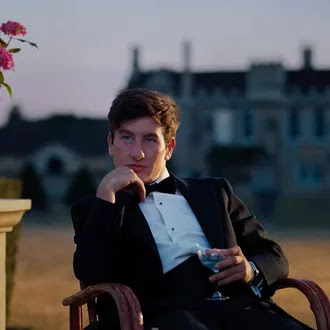
     Drowsy looking Barry Keoghan, nominated last year for “The Banshees of Inisherin,” plays Oliver Quick (a name and character clearly inspired by Dickens), a nerdish middle-class student drawn into the obit of the rich, snobbish kids by Felix Catton (“Priscilla’s” Elvis, Jacob Elordi). In fact, Oliver has fallen hard for the tall, dark young man, despite Felix’s nonstop womanizing.

       After Oliver reveals to Felix that his drug-using father has died, Oliver is invited to spend the summer at the Catton estate. The film settles into a version of a corrupted “Downton Abbey,” updated to the 21st Century, with Richard E. Grant and Rosamund Pike deliciously playing the lord and lady of the manor. Also hanging around is daughter Venetia (Alison Oliver), cousin Pamela (an unrecognizable Carey Mulligan) and a classic stern, protective butler (Paul Rhys).

     Writer-director Fennell clearly enjoys pushing the envelope of good taste and expectations, as she did in “Promising Young Woman” (2020), but in “Saltburn” (the name of the Catton’s castle) she undercuts her own clever writing and characters for little more than shock value.          

PHOTOS:

Carey Mulligan and Bradley Cooper in “Maestro”  (Netflix)

Jeffrey Wright in “American Fiction.” (MGM)

Adam Driver in "Ferrari"  (Neon)

Barry Keoghan in “Saltburn”  (MGM)


Friday, November 24, 2023

November 2023


KILLERS OF THE FLOWER MOON (2023)

      For most of our history, at least until the late 1960s and in many cases much longer, most of white America lived in blissful ignorance of the mistreatment and injustice faced daily by millions across the country. And even if they knew, they didn’t care—the inequities faced by African Americans, Latinos, Asians, anyone who dared to admit to being gay or lesbian, non-Christians and, first among those who needed to be pushed aside, Native Americans, weren’t worth worrying about.            

      In the last 30 years, journalism—through newspapers, magazines, books and television—along with the entertainment industry started taking notice of on-going and historic injustices, helping to shake more Americans out of their child-like blindness. Based on David Grann’s riveting chronicle of the inhuman treatment of the Osage Indians after oil production began on the Oklahoma tribe’s land in the early part of the century, Martin Scorsese’s epic movie, set in the 1920s, packs an emotional punch in every scene, every conversation, every closeup as very bad people assimilate into the community to enrich themselves.

      Capturing the world of the Osage and detailing how these events impacted individuals is Scorsese’s greatest accomplishment in this film. Much credit must be given to Jack Fisk, the veteran production designer (he’s just three years younger than the 81-year-old director) who has created a community that feels as authentic as the hard-edged dialogue by Eric Roth and Scorsese.

    As white men flood into the area to “find” their fortune, the town’s boss, William Hale (a commanding Robert De Niro) pushes the young men to woo the unmarried Native women. Once married, the women unexplainably take ill and die, leaving the riches in the hands of their white husbands. This happens over and over again, yet law enforcement, under Hale’s thumb, does nothing. (The Osage can’t even spend their own money without getting a white man’s approval.)

     At the center of the picture is Mollie (Lily Gladstone in a soft-spoken but startling powerful performance), one of the richest of the Osage who seems to have resisted the advances of white men until the inarticulate war veteran Ernest (a miscast Leonardo DiCaprio) arrives in town. He’s the nephew of Hale, but seems to be a sincere, if naïve (and way too old), suitor of Mollie.

     Later, the death of her sister spurs Mollie to seek an outside investigation, but Hale manages to hijack those efforts. Frustratingly, the Native people seem blind to the fact that the beloved Hale is working against them. Not until the FBI takes an interest (Jesse Plemons plays the lead investigator) does there seem to be much hope that justice will be served.

     At three and a half hours, the film is unavoidably episodic, and sometimes feels choppy and repetitive—the picture reminded me of Scorsese’s “Casino” and “The Irishman,” long, rather labyrinth chronicles that, despite numerous brilliant sequences, don’t always hold together as narratives. But it’s not just the length:  I’ve seen plenty of 90- minute films that felt much longer.

      While Gladstone and De Niro have clearly defined roles, and give performances worthy of Oscar nominations, DiCaprio seems a bit misguided in trying to capture the difficult character of Ernest. As he descends from a rather innocent pawn of his uncle and truly in love with Mollie to an active participant in the evil conspiracy against the Natives, he seems unchanged. Not to mention that it makes no sense that a 49-year-old actor is playing the role.

     He clenches his jaw too many times rather than provide some insight into what is going on inside his head. That’s probably a fault of the script and direction, but the result creates a crucial weakness at the center of the film.

     Gladstone, whose ethnic background is Blackfoot, is so good that she almost makes you forget the flaws of DiCaprio’s performance. Her previous best-known roles were in Kelly Reichardt films, “Certain Women” and “First Cow.” “Killers of the Flower Moon” should make her a star.

     With a director of Scorsese’s stature—certainly one of the 10 greatest in American film history—there is always the question of how a new film stacks up with his other works. Despite what many reviewers are proclaiming, this isn’t a great film (a great message, a great story, but not a great motion picture), not ranking with the director’s greatest works, which are among the best American films ever made. Pending a second viewing, I would place it among “The Departed,” “The Age of Innocence” and “The Irishman.”


THE HOLDOVERS (2023)

     Alexander Payne, who has directed some of the best films of the past 30 years, had me at the opening credits of his new film, recreating the look of a 1970s release, down to the style of the frame showing the picture’s rating.

      The 70s theme continues as director of photography Eigil Bryld (“In Bruges”) recreates the soft, low-lit cinematography of the era, appropriate for this story set in a New England boys’ prep school in the winter of 1970.

      Paul Giamatti plays the school’s disliked ancient history teacher who gets stuck babysitting a group of students who remain on campus over the Christmas holidays.

     After a few days with the rather cliché group of students, a creaky plot turn leaves just Mr. Hunham, the school kitchen manager Mary (a touching performance by Da’Vine Joy Randolph) and one of the smart-aleck high schoolers, Angus (Dominic Sessa), whose parents decided to vacation on their own.

      These three bring their personal quirks and tragedies to the table that eventually brings them together in the kind of unique family unit that was a product of the era’s crumbling traditional values.

      Payne, like many contemporary filmmakers, has made few films since his feature debut “Citizen Ruth” in 1996, directing only seven features over the next 25 years. (That may speak to the current state of film funding.) But those films have been impressive, including “Election” (1999), “About Schmidt” (2002), “Sideways” (2004), “The Descendants” (2011) and “Nebraska” (2013).

      Randolph, who deserved an Oscar nomination for her performance as an over-the-top nightclub performer in “Dolemite Is My Name” (2019), serves as the truth-teller of the group as she deals with the first holiday after the death of her son, who had been a student at the school before going to Vietnam.

     Giamatti gives his finest film performance, subtly unfolding what begins as a cliched pompous teacher, giving way to a man burdened with his insecurities and unhappy past. The role and the film serve as a reminder that the virtues of 1970s films, so rich in believable characters and with scripts anchored to lived lives, are just as relevant today.


NAPOLEON (2023)

      Director Ridley Scott has made a career recreating past and future worlds. From “Gladiator” and “The Kingdom of Heaven” to “Alien” and “Blade Runner,” the filmmaker shines in immersing the audience in the atmosphere of these unfamiliar environs.

     His new film, spanning the adult life of the legendary general, while in many ways playing out like a 1930s MGM spectacular, offers a series of immaculately designed set pieces—from the candle-lit intimacy of Josephine’s boudoir to spectacular reenactments of the dictator’s victories and final loss. Much credit must go to Scott’s regular collaborators, production designer Arthur Max and cinematographer Dariusz Wolski.

    Joaquin Phoenix plays Bonaparte not as the supremely confident, dignified “great man,” but instead as an impulsive, needy egotist whose military smarts and brazen ambition elevate him to the highest ranks. Who knows how true the portrayal is to the real man, but it humanizes him, while offering little to admire. Phoenix does an impressive balancing act and makes great use of that famous bicorne hat, worn sideways.

     Josephine, played with a very modern smirk by Vanessa Kirby, holds such a strong power over Napoleon—sexually and psychologically—that you could almost assume that their breakup contributed to Waterloo. Kirby, so memorable as Princess Margaret in “The Crown,” the mother in “Pieces of a Woman” and the White Widow in the recent “Mission: Impossible” films, again dominates every scene she’s in. Scott clearly wanted his Josephine to rule over Napoleon and he found the perfect actress.

      As far as the rest of the cast, they’ve been turned into the scenery—no one stands out.

     Like so many bio-pics and historical drama, the film, written by David Scarpa, too often feels like clips from a longer, more interesting picture. It’s only when Scott takes the film outside to the battle field that the story takes flight. Few combat scenes are equal to this film’s recreation of the Battle of Austerlitz, during which the French lured tens of thousands of Russian troops onto a field of ice. 

     While I hate to even mention the phrase “directors-cut” when writing of Scott (how many versions of “Blade Runner” did we endure?), apparently, he plans to release a four-hour version (the theatrical cut runs 2 hours and 38 minutes) in December on Apple TV+. I suspect the longer film may smooth out the flaws of this version; we shall see.


STOP MAKING SENSE (1984)

     It has become accepted judgment that this concert film of a Talking Heads’ performance at Hollywood’s Pantages Theater ranks as the greatest of the genre. Maybe if you are a huge Talking Heads fan it is, but for my taste, I’d lean toward “The Last Waltz” or “Concert for Bangladesh.”

     Not that director Jonathan Demme (“Silence of the Lambs” and numerous music videos and films) doesn’t do a superb job in capturing the energy and quirkiness of the post-punk, New Wave rock band and, most particularly, its off-center lead singer, David Byrne. They emerged as radio favorites in the late 70s and were done by the mid-80s.

    Most distinctively, Demme starts the show with a bare stage—Byrne comes out for a solo sound check—and then slowly fills the space with the instrument set-ups, all as the band bangs out its greatest hits. The film peaks with the incendiary social commentary song “Life During Wartime,” Byrne signature single.

     Re-released to theaters recently (though apparently with no additional footage), it holds up well 39 years later, though the songs, all compelling on their own, sound very similar when performed back-to-back-to-back. The band even turns Al Green’s R&B classic “Take Me to the River” into a Talking Heads song.

     Byrne, who dons his famous oversized suit for a couple of numbers near the end of the show, is more performance artist than rock singer—a combination of David Bowe, Elvis Costello and Laurie Anderson—backed by the funky bass line of Tina Weymouth.

     I enjoyed seeing and hearing the band rip through “Psycho Killer,” “Burning Down the House,” Once in a Lifetime” and its other hits on the big screen (I’d only seen it on VHS previously), but the “greatest”?


PRISCILLA (2023) and THE KILLER (2023)

       I can withstand bad acting, bad screenwriting, even incompetent directing, but not the most egregious cinematic sin: being boring. These two movies share nothing except that the characters in both seem to sleepwalk through the performances and the plots are equally dreary.

        Sofia Coppola’s “Priscilla” positions itself as a kind of rebuttal to Baz Luhrmann’s “Elvis” (2022), in which the wife of rock ‘n’ roll’s king spends most of the film in the background. The new movie, based on Priscilla Presley’s 1985 memoir, doesn’t shy away from the clearly inappropriate early relationship between the pair. When they meet, she’s a very-sheltered 9th grader from Texas whose father is stationed in Germany, at the same base where Elvis is doing his required military service (living in luxury few G.I. ever enjoyed).

      Once Presley returns to Memphis, Priscilla visits and, too soon, is living there, all approved by her parents. Yes, it’s 60 years ago, but, even then, this young teen living among the adults at Graceland was a bit strange. Though the film goes to great lengths to show Elvis refusing the girl’s overtures for sex, even as they share a bed, I didn’t believe it for a Memphis second. 

     While Elvis never stops telling her how much he loves her, the soft-spoken Priscilla barely casts a shadow on the Graceland walls, as Presley hangs out with his “Memphis mafia” buddies when not away from home shooting movies and having affairs with his co-stars. (At one point, newspaper stories report that he’s engaged to Ann-Margret.)        

      While every viewer knows from the first frame that this relationship is destined for disaster, I imagined that there must be something interesting about it to make it worthy of a two-hour film. I was wrong.

     Coppola has made a career directing films in which not very much goes on—it’s almost her signature. This one takes the cake: a good portion of the picture depicts Elvis and Priscilla engaging in childish games (remember, no sex) in their bed. It’s all embarrassingly dull.

      As Priscilla, Cailee Spaeny, in her first major role, doesn’t so much give a performance as model for the camera, looking like a lost deer. The script, by Coppola, gives her virtually no personality and nothing of interest to say.

       While I wasn’t impressed with Austin Butler’s Oscar-nominated turn in “Elvis,” at least he brought out Presley’s energy and ambition. Jacob Elordi, a tall, thin actor who bears no resemblance to the singer (distractingly, he’s 5 inches taller than the real Elvis) plays the role as if no one told him he was portraying a rather famous person. Previously, he was a star of the Netflix movie series, “The Kissing Booth.”

      For some reason, Colonel Parker isn’t in the film at all. Odd, considering that most accounts have him making every important decision in Presley’s life. He might have livened up this film (where is Sofia’s old friend Bill Murray?); someone needed to light a fire under this story.

     While I wasn’t surprised at the somnolent manner of Coppola’s picture, I never expected David Fincher to turn “The Killer,” a tale of a failed assassination attempt, into such a slog.

     Michael Fassbinder is the professional hitman who missed and then goes on a vengeance-fueled killing spree knowing that his mistake will likely cost him his life.

    The film seems to be influence by “Point Blank,” but never generates the intensity or outrage that Lee Marvin brought to the violent 1967 classic. It’s just one senseless killing after another, including innocents.

     Without giving away one of the few lighthearted quirks of this mostly repetitive script, the highlights of the film are the names the assassin uses when checking into hotels. Sadly, that minor note is the only memorable aspect of this strangely subdued picture.

        I would have preferred to see a film about the killer’s storage locker, where he keeps an astonishing collection of guns and accoutrements to hide his identity. I can’t imagine how long it took him to accumulate all of this. He even jokes about what the bidders on “Storage Wars” would make of his collection. 

       Late in this slickly directed, but hollow film, the assassin encounters a very rich woman played by Tilda Swinton, which I suspect was the entire reason to make the film. It would have been a very fine 10-minute short.


NYAD (2023)

     In the 1970s, Diana Nyad emerged as one of the most famous female athletes after a string of long-distance swims that set records around the globe.

    After a career with ABC Sports (when it was a major player) and other outlets, Nyad decided, at age 64, to again attempt her dream swim: Cuba to Key West, about 100 miles infested with sharks and other dangerous sea critters.

    Annette Bening, looking much like the real Nyad, plays this self-centered, sharp-tongued woman as she trains and then swims the Caribbean Sea.

    Two-time Oscar winner Jodie Foster plays Bonnie, her coach and best friend—both are lesbians but not lovers—showing great patience with the demanding Nyad, who refuses to accept the general opinion that she’s too old to attempt this seemingly impossible feat.

     It’s a great story and these two fine actresses are convincing as they recreate this often-fraught relationship. What left me cold—the film is streaming on Netflix—was the mixing of video of the real Nyad with the performances by the actors. The film, directed by Elizabeth Chai Vasarhelyi and Jimmy Chin, the husband-and-wife team who made the 2018 Oscar-winning documentary “Free Solo,” starts with five minutes worth of clips from Nyad’s early career (including an appearance on the “Tonight Show with Johnny Carson”) which I could forgive if the filmmakers didn’t keep coming back to clips through the picture.

     They can’t seem to decide if they are making a feature or a documentary.

     The movie touches lightly on the inappropriate actions of Nyad’s youth swim coach but that’s not a major concern as the filmmakers clearly are looking to paint a story of heroism.

     For me, the unpleasant manner of Nyad, which Bening and screenwriter Julia Cox (working from Nyad’s memoir), don’t shy away from, made it hard to root for the woman. But Bening, as usual, is outstanding. She’s recently done well playing real people, including Sen. Dianne Feinstein in “The Report” and actress Gloria Grahame (with whom she bears a strong resemblance) in “Film Stars Don’t Die in Liverpool,” and also delivered memorable work in “The Kids Are All Right” (2010) and “20th Century Women” (2016). Her post-50 career has defied Hollywood’s agism toward women.   

     Also giving a memorable performance is Rhys Ifans (“Notting Hill”), as a boat owner who becomes a crucial member of Team Nyad. The late-night phone conversation between him and Nyad is the film’s most touching moment.


APPOINTMENT WITH A SHADOW (1957)

      One of the most difficult roles to play convincingly is that of a drunk. There’s no right way as every alcoholic acts differently, yet rarely do actors manage to bring drunken authenticity to the screen, instead overacting as if they have seen “Arthur” too many times. Most famously, Ray Milland in “The Lost Weekend” (1945) and Jack Lemmon in “The Days of Wine and Roses” (1962) earned acclaim, if not total success, as heavy drinkers.

      That’s why I was impressed with little-know actor George Nader in this low-budget, 72-minute crime picture. Nader, who spent his entire career in Bs, was most famous for taking the sword to protect Rock Hudson; the magazine Confidential outed him and passed on exposing the bigger star.

     The film opens with Nader’s Paul Baxter passed out at O’Connell’s Bar, his favorite dive. We soon learn that he’s an unemployed reporter whose drinking cost him his job. Meanwhile, his girlfriend (Joanna Moore, who had a long career in serial TV) and her brother (Brian Keith), who is also a police detective, have cooked up a plan to get him back on his feet.


     The detective gives Baxter exclusive access to a police arrest of a notorious mobster. The reporter manages to stay sober and shows up at the scene, witnessing the police shooting a man as he leaves a restaurant. But he also spots the actual criminal watching the scene along with him.

    Of course, no one believes this unreliable drunkard’s story that the cops shot the wrong man, but he pursues the real guy while uncovering the plot that left an imposter dead.

    With a star in the role, this might have been a successful A picture; the script by Alec Coppel and Norman Jolley from a story by Hugh Pentecost (and directed by actor Richard Carlson) has some poignant soliloquies and sharp observations about human fragility.

     I found the film by chance on YouTube when I was searching for the highly regarded noir “Appointment with Danger” (it’s not available). Not sure how good the other “appointment” is, but Nader’s performance made this one memorable. 


PHOTOS:

Leonardo DiCaprio and Lily Gladstone in "Killers of the Flower Moon."  (Apple TV+)

Joaquin Phoenix as "Napoleon."  (Apple TV+)

Cailee Spaeny and Jacob Elordi on the long-awaited wedding day in "Priscilla." (A24)

George Nader plays a drunk in "Appointment with a Shadow." (Universal Pictures)