Thursday, November 17, 2022

November 2022


TÁR  (2022)

      This film quickly establishes orchestral conductor Lydia Tár, whose distinguished career is chronicled in an on-stage interview with New Yorker writer Adam Gopnik (as himself), as a self-assured, name-dropping intellectual who rarely censors her opinions, barley notices those who cater to her every whim (including an ambitious assistant played by Noemie Merlant) and enjoys being feared as she rushes through her life.

    In a seminar at The Juilliard School, Tár (a steely, strutting Cate Blanchett) berates a student composer while establishing the central question of the film: should artists be judged by their art or how they lived their lives?  After the young man informs her that he’s not interested in Bach because he was a straight white man who sired many children, Tár throws the same judgment back at him: if he creates some important music does he want it judged by its artistic worth or by his personal life?


      Unlike most American films, “Tár,” written and directed by Todd Field (“In the Bedroom,” “Little Children,”) focuses on seemingly mundane aspects of a life—long scenes of rehearsing Mahler’s 5th with the Berlin Symphony, discussions with the conductor’s assistants and agent and complaining to her partner (Nina Hoss), who is the orchestra’s first violinist (read into that what you want).

     Nearly two hours into the film, rumblings of a plot being to stir when a video of her the Juilliard class (editing to make her look bigoted) surfaces and, simultaneously, a woman she had rejected for a symphony position, and may have had a relationship with, commits suicide.

    The filmmakers don’t push for a judgment on Tár; instead leaving the controversies she faces vague and unresolved. But what’s crystal clear is that Tár’s refusal to recognize the tenor of the times spells her doom. What you are allowed to say, do or write and how you respond to others has changed dramatically in the past 10 years.

     Just because she’s a self-described “U-haul lesbian” and a protégé of “Lenny” (legendary conductor Leonard Bernstein) doesn’t exempt her from the vagaries of societal expectations. Even her clumsy attempts to bring the orchestra’s new, young cellist (Sophie Kauer) into her orbit can be seen through two lenses. Is she a boss playing favorites in hopes of a sexual relationship or a woman searching for love?

     As much as I enjoyed this film, it requires hard work. Blanchett, giving an extraordinary performance, one of her best in a stellar career, rips through the musical-jargon filled dialogue in a no-nonsense, keep-up-if-you-can manner. At least a passing knowledge of classical music helps as nothing is explained.

     Tár’s fate and what it all means remains a bit of an unsolved puzzle right to the sad and shocking ending. (Some critics have speculated the final act is a dream.) 

      Writer-director Field hadn’t directed a film, nor acted in one, since 2006, having worked on a pair of high-profile novel adaptations that were never competed—Cormac McCarthy’s “Blood Meridian” and Jonathan Franzen’s “Purity.” But, after his previous work and “Tár,” it’s clear he remains one of the cinema’s finest writers and most interesting filmmakers.


THE WOMAN KING (2022)

     Not long into watching this intense story of 19th Century West African tribal warfare, I recognized its source—John Ford’s classic Westerns.

     That the film utilizes the format created by Ford and other 20th Century directors of Westerns in no way diminishes what director Gina Prince-
Bythewood (“Love and Basketball”) and writers Dana Stevens and Maria Bello (yes, the actresses with her first writing credit) have accomplished here. As another cliché goes: there are no new stories, just new ways to reimagining them.

     The result is a first-rate picture, with closely observed characters, the usual generational conflicts and action sequences that makes Marvel movies look like video games for children.

     Viola Davis plays Gen. Nanisca, the John Wayne character, who leads the Dahomey tribe’s already legendary troop of female warriors. If she seems a bit old, at 57, for the part, she makes up for it with her fierce, determined attitude, a brutal back story and a take-no-prisoners stance.

    Of course there’s a neophyte member of the troop---Nawi (an excellent Thuso Mbedu)---who struggle to earn the respect of her elders but eventually becomes a key member of this impressive fighting force. (In the Ford films, John Agar would serve in this role.)

    And not leaving any element of classic storytelling out, there’s also a tough but beloved “drill sergeant”-type (think Ward Bond in a dozen films) played by Lashana Lynch, who whips the new recruits into shape.

     The reason behind the tribe’s reliance on women to fight their battles is that the slave trade has decimated the male population. The way that Prince-Blythewood deals with this issue turns what could have been an ordinary actioner into something more relevant. Not only does the film show the results of slavery at its source but also explores how the tribes themselves grew rich by selling off its population and those of its rivals captured in battle.

    The film pivots on the decision by the tribe (led by the King played by John Boyega) to either take the easy route to wealth and continue to supply the slavers or take a moral stand against it.

   It’s a story that has too long been ignored by Hollywood: looking at Africa in a real way (not the comic book version in “Black Panther”) where heroic and heartbreaking lives were playing out with equal drama to those in Europe or America.

    And it is, to some degree, based on real events. In the area that now is the country of Benin, adjacent to Nigeria, a feared group of woman warriors fought many vicious battles with neighboring tribes. Whether this tribe considered dropping out of the slave trade is most likely a stretch.

     Davis should score her fifth Oscar nomination and Mbedu, a South African actress in her second feature, also deserves consideration. Equally impressive is Polly Morgan’s vivid, dexterous camera work.


JOE MACBETH (1955)

    I have seen plenty of film adaptations of “Macbeth,” including Roman Polanski’s and Orson Welles’ versions, Akira Kurosawa’s magnificent “Throne of Blood,” along with recent efforts featuring four of the best actors in film—Denzel Washington and Frances McDormand directed by Joel Coen and Michael Fassbender and Marion Cotillard in Justin Kurzel’s film. But this 1950s noirish mob picture might be the most unusual and creative.

    Paul Douglas, best known for “Angels in the Outfield (1951) and “Clash by Night” (1952), plays Joe Macbeth, an underboss to the Duke. If you know your Shakespeare, it’s not hard to guess what Duke’s future holds.

     Interestingly, he’s stabbed to death while out for a swim near the estate Macbeth has taken over when he executes another mobster for Duke.

    There’s a Banquo (Sidney James as Banky)—Macbeth’s comrade in arms who ends up as a victim—and his son (a fiery Bonar Colleano), here a twentysomething mobster whose fate in the original play is vague. He plays a crucial role as an outspoken critic of the power-hunger Macbeth.

    And, of course there’s a Lady Macbeth, played by the underrated Ruth Roman (“Tomorrow Is Another Day,” “The Far County”), pushing the indecisive husband to take what the fortune teller (a feisty Minerva Pious), subbing for the witches, predicts.

    The strength of the picture is its screenplay by the great Philip Yordan, who had just won an Oscar for the Western “Broken Lance.” Yordan scripted some of the best films of the 1950s, including “Detective Story” (1951), “Johnny Guitar (1954) and “The Big Combo” (1955), “The Harder They Fall” (1956) and “God’s Little Acre” (1959). In “Joe Macbeth,” he deftly combines the film noir cliches with the Bard’s bloody tale.

    Director Ken Hughes, a Brit whose oddball career includes the inane musical “Chitty Chitty Bang Bang” (1968) and Mae West’s comeback attempt “Sextette” (1977), shows some stylish touches in the final sequence and makes interesting use of severe closeups, but most of the film looks like a TV production.

   This is very much a B-film, but offbeat enough to merit a look. Maybe the most interesting decision the filmmakers make is that no one in the film takes note of the parallels to the Scottish play. Not that the members of this crime group spent much time in English Lit, but surely someone would have noted their boss’ name as sounding somewhat familiar?


THE BANSHEES OF INISHERIN (2022)

     The team that gave us “In Bruges,” one of the true gems of the last 20 years, reunite for this seemingly simple tale of a pair of friends who live on a desolate island off the coast of Ireland, circa 1920s.

    The leisurely picture grows repetitive after Colm (Brendan Gleeson) tells his long-time drinking buddy Padraic (Colin Farrell) that he no longer enjoys his company, demanding that he stop talking to him. Yet “Banshees” shines as a portrait of a world that no longer exists while exploring timeless issues of the importance of friendship and what constitutes a worthwhile life.

     Farrell, giving what may be the best performance of his career, and writer-director Martin McDonagh create a classic small-town character who lives for his afternoon beer and has little interest beyond his uneventful life (he resides with his unmarried sister and has a pet mule). Colm, a fiddle player who wants to write a piece of music that will outlive him, has grown tired of listening to Padraic’s nonsense and seeks peace.

     That conflict makes up almost the entirety of this episodical film. Yet it’s filled with hilarious, ridiculous and touching moments are just as impactful as the main plot, not unlike McDonagh’s last film, “Three Billboards Outside Ebbing, Missouri.”

    While Gleeson has the less interesting role, he is, as in so many of his films, a charismatic force; in many scenes in “Banshees” just by sitting silently in his humble home. His 67-year-old face is like a map of Ireland.  

     Farrell, whose best work has mostly been done in little seen pictures including “Tigerland” (2000), “The New World” (2005), “In Bruges” and “The Lobster (2015), deserves Oscar consideration for his Padraic. You can sympathize with this limited, but good-hearted man while understand why Colm wants nothing to do with him. The sadness you see in his face as he keeps trying to resurrect their friendship is heartbreaking.

     Among those populating this rocky island are a nosey store owner, a bully of a policeman and his troubled son (a memorable Barry Keoghan), an elderly woman who could be related to one of Macbeth’s witches and Siobhan (Kerry Condon), Padraic patient sister who has dreams beyond the confines of Inisherin.

     The picture grows unnecessarily intense in the last act, a metaphor, I assume, for the unforgiving world they lived in, but breaking the comical magic it had built for the first hour or more. Yet the time spent with this collection of very recognizable and unforgettable characters makes up for the picture’s extremes.


BLONDE (2022)

     As someone who has never bought into the deification of Marilyn Monroe, I find myself in the surprising position of defending the reputation of the actress-model-celebrity against this bleak, disturbing profile.

     Joyce Carol Oates, among the finest novelists of the past 50 years, wrote the fictional account of Monroe’s life on which the film is based. In other words, the reader/viewer has no idea what parts of the profile are true and what are imaginary. Unless done as a satire, I’m not sure there’s much value in this approach to a life. And it becomes more troubling when acted out on film.

      Director Andrew Dominik (“The Assassination of Jesse James…”), who also adapted Oates’ novel, and actress Ana de Armas (“Knives Out,” “No Time to Die”) depict Marilyn as a socially inept, easily manipulated child-woman who, damaged by the absence of a father, never shows the ability to make the most basic of decisions about her life. Even when she’s discussing Chekhov with future husband Arthur Miller (Adrien Brody, billed as “The Playwright”), her eyes and voice indicate a woman on the verge of a nervous breakdown. To drive home her father issues, she calls both husbands “daddy.”

     “Blonde” touches some highlights of Monroe’s life, while skipping large, important periods, leaping from a childhood dealing with her insane mother (Julianne Nicholson, giving the film’s only believable performance) to her early film roles. The film erases her first marriage and her pre-Hollywood days, when, according to most accounts, Norma Jeane was a very normal young lady.

    While the film avoids showing her interactions with other actors, it portrays her first serious Hollywood relationship, a ménage à trios with Charlie Chaplin Jr. and Edward G. Robinson Jr. (reportedly, she dated both but not, as the movie depicts, at the same time). Later they are shown trying to blackmail her second husband, baseball great Joe DiMaggio (Bobby Cannavale) with nude photos of Marilyn. In actuality, she had appeared naked in the first issue of Playboy magazine, a year before she married DiMaggio.


     But facts are secondary to “Blonde” as it tries to explain her journey through the sexism of the 1950s while documenting her inability to give birth despite various pregnancies. Surprisingly, only one scene shows the alleged relationship with President John Kennedy; by then she’s little more than a drugged-up rag doll, at least according to the film.

     The picture skips from the filming of “Some Like It Hot” (her best performance) to her final days in 1962, having ignored her work on “Monkey Business” (1952) opposite Cary Grant, “Bus Stop” (1956), “The Prince and the Showgirl” (1957) opposite Laurence Olivier (see “My Week with Marilyn” for what seems like a more believable portrayal) and “The Misfits” (1961), starring Clark Gable and Montgomery Clift. It seems obvious why the film ignores this period of her career: it contradicts the premise that she was falling apart, misused by Hollywood and incapable of simply doing her job.

      Overall, this is a cold and lifeless film that jumps from one bad moment to the next (usually ending with Marilyn topless). It’s popular to blame the studio system, run by misogynistic bullies, for the tragedies: Monroe, Judy Garland and a dozen other lesser knowns. Yet, as portrayed here, she would have lived a terrible life no matter what her profession, a teacher or CPA or sales clerk.


RAWHIDE (1951) and THE MAN FROM COLORADO (1948)

   From the late 1940s through the 1950s Westerns reached their apex, led by filmmakers John Ford, Howard Hawks, Anthony Mann and Budd Boetticher. I recently saw two rarely shown cowboy pictures that may not be great films but deserve recognition as better than standard Hollywood horse opera.

   With “Rawhide” starring Tyrone Power and Susan Hayward, I assumed I would be seeing a cliché-filled story about a frontier romance but instead it’s an intense, brutal, psychological study that plays out more like the B-westerns of Boetticher and Randolph Scott than a picture by studio veteran Henry Hathaway and two star actors.

    Not long after Vinnie (Hayward) and a young child (it turns out to be her deceased sister’s) arrive at a remote stagecoach stop, Rafe, an escaped con (Hugh Marlowe, far from his usual urbane roles), and his gang kill the station manager (Edgar Buchanan) and take her and the assistant manager Tom (Power) prisoner. While they all wait for a gold shipment that Rafe plans to rob, the film plays out like a dusty version of “Key Largo,” a claustrophobic waiting game with Vinnie constantly under danger from the psychotic Tevis (Jack Elam, of course).      

    Cinematographer Milton Krasner (“All About Eve,” “Three Coins in the Fountain”) shoots the picture like a film noir, filled with interesting shadows and angles. This nail-biter was written by Dudley Nichols, one of the most successful screenwriters in Hollywood history, penning scripts for “The Informer” (1935), “Bringing Up Baby” (1938) and “Stagecoach” (1939), among dozens of others.

    Hathaway, a child actor in silents who was still directing in the 1970s, was best known for “The Lives of a Bengal Lancer” (1935) and “Kiss of Death” (1947) before this picture. Later, he directed parts of “How the West Was Won” (1962) and guided John Wayne to his best actor Oscar in True Grit” (1969).

      In “The Man from Colorado,” William Holden and Glenn Ford, Columbia Pictures twin stars of the 1940s and 50s, shared the bill, as they did in “Texas” (1941).

    It begins with a vicious scene of Northern troops, led by Ford’s Owen Devereaux, killing a regiment of Confederates after they raised the white flag. (We’ll ignore the fact that there actually weren’t any Civil War confrontations in Colorado.)

     Later, he’s appointed the region’s judge by the local silver baron (Ray Collins), who has taken over (many would say stolen) the stakes of dozens of men who volunteered to serve in Ford’s regiment. Though outrageous, it was legally sound—the men had failed to work the mines during a three-year period, so it was up for grabs.

     Holden plays Del Stewart, the more sensible best friend of Owen, who serves as the court’s Marshall. But it is a tenuous relationship as Owen’s wife (Ellen Drew) is coveted by Del, who also suspects that his friend suffers from mental problems.

     Never before have I seen a picture that addressed the possibility of Civil War vets suffering from battle fatigue or any type of post-war stress issues. Ford does a nice job of showing the Jekyll and Hyde nature of Owen as Del eventually takes sides with the victimized citizens against his friend and Collins’ greedy monopoly.

    Though B-movie director Henry Levin doesn’t bring much in the way of style to the film, it is well written by Robert Hardy Andrews and Ben Maddow from a story by Borden Chase (“Red River,” “Winchester ‘73”).

      Holden, of course, went on to become one of the most enduring stars of the cinema, winning a best actor Oscar for “Stalag 17” (1953) along with top lining four of the greatest films ever made, “Sunset Boulevard” (1950), “The Bridge on the River Kwai” (1957), “The Wild Bunch” (1969) and “Network” (1976).

     Ford’s best work can be seen in crime pictures like “Gilda” (1946) and “The Big Heat” (1953) and the Western “3:10 to Yuma” (1957). Even though his choices in roles landed him in many mediocre films, Ford’s combination of soft-spoken sensitivity and tough-guy determination made him a popular star throughout the 1950s.


AMSTERDAM (2022)

    It’s baffling that the same director who made first-rate pictures “The Fighter” and “Silver Linings Playbook” back-to-back supervised the ridiculous chaos of this dreary Coen brothers imitation.

    This isn’t David O. Russell’s first disaster; he made “I (Heart) Huckabees” after directing “Flirting with Disaster,” one of the best comedies of the 1990s, and “Three Kings,” a popular action picture. Then, in 2015, his “Accidental Love,” despite enthusiastic efforts by Jessica Biel and Jake Gyllenhaal, was so disappointing that Russell had his name removed from the final print. Not helping his rep, the director has been repeatedly accused of abusive behavior on his sets.

    The primary action of “Amsterdam” takes place in 1933 New York, when three friend from the World War I battlefield, played by Christian Bale, John David Washington and Margot Robbie (three of Hollywood’s best actors), try to uncover those responsible for the poisoning of a heroic general and the murder of his flighty daughter (Taylor Swift).

     Nothing makes much sense or generates much energy as the bad guys are mostly hiding in plain sight.

     The idea is based on the very real attempt by a cabal of American businessmen to install a dictator and end democracy in the U.S. in the 1930s. (Similarities to 2022 are not coincidental)

     Like the writer-director’s “American Hustle” and “Joy,” the actors are occasionally amusing—Bale’s Dr. Berendsen is half crazy, half genius, while Washington and Robbie are convincing as an on-and-off couple—but mostly wasted.

     Also in this impressive cast are Rami Malek as an eccentric bird-loving millionaire, Zoe Saldana as a sympathetic medical examiner, Michael Shannon and Mike Myers as some kind of federal agents and Robert De Niro, who almost saves the film as another WWI general who befriends the sleuthing trio. 

    While no filmmaker scores a success every time out, Russell’s highs and lows have been especially extreme, despite the powerhouse lineup of stars he attracts for every film. 


PHOTOS:

Cate Blanchett in "Tár." (Focus Features)

"Joe Macbeth" poster (Columbia Pictures)

Bobby Cannavale and Ana de Armas in "Blonde."  (Netflix)

Christian Bale, Margot Robbie and John David Washington in "Amsterdam." (20th Century Studios) 


Sunday, September 18, 2022

August 2022


VIVRE SA VIE (1962) and HELAS POUR MOI (1993)

      As the tributes poured in following the death of Jean-Luc Godard, most declaring him as the most influential filmmaker of his generation, I rewatched a few of his films in hopes of seeing that brilliance others write about.

     While I haven’t seen his entire filmography, I have seen 20 of his films and, aside from his audacious, entertaining and, yes, influential debut, “Breathless” (1960), there’s an argument to be made that he’s the least interesting director to emerge from the French New Wave. Truffaut, Chabrol, Melville, Rohmer, Resnais all show a stronger sense of storytelling and character development while also having something intelligent to say. In most cases, their films are the opposite of what Hollywood movies represent; in Godard’s case, I’d have a hard time classifying his work as filmmaking.

      By his fourth picture, “Vivre Sa Vie” (My Life to Live), Godard seems to have run out of ideas, offering up this disjointed—though coherent compared to later works—tale of a young French woman Nana (his paramour at the time Anna Karina) who, lacking money to hold on to her apartment, takes up prostitution.

     The camera lingers over Karina while she has pointless conversations with a variety of men and, at one point, the film turns into a Q&A about the life of a hooker. Clearly that was provocative in 1962 but it’s rather dull stuff unless you're 12.

        As the years went on, Godard’s movies became less cinematic and more didactic, essentially excuses for long discussions of philosophical issues. At one point in the mid-1960s, he all but gave up on commercial filmmaking and focused on anti-war, anti-capitalism propaganda films.

     “Helas Pour Moi” (Oh, Woe Is Me) is an odd mixture of politics and fantasy—God takes over the body of Simon (Gérard Depardieu) so he can sleep with his wife, Rachel. Scenes rarely connect to each other and most of the talk is little more than platitudes.

     I also rewatched “Goodbye to Language” (2015), his last film to receive mainstream attention. While just over an hour, it’s hard to sit through. He seems especially fascinated by Mao and Hitler and shooting over saturated forest and streams. And while one could make a case that nearly every film of the 1960s and ‘70s was sexist, Godard never grew up. He seems especially obsessed with the female body, filling the screen with nudity without a point.

      To me, Godard’s art was artless; his films a scattershot of images coupled with actors speaking to the audience and not to each other. I’m all for the cinema as a form of personal expression, but Godard’s movies remind me of the work of an earnest film school undergrad who just read Marx.

      I have always been arrogant about my opinions—I’m right and everyone who disagrees is wrong—but in this case, I think everyone else is right and I’m wrong. There’s got to be something there if all these critics and filmmakers who I admire find Godard so important. Not to mention the straight line between Godard and two of my favorite directors, David Lynch and Jim Jarmusch. I’m just not seeing or hearing what they do.

     More provocateur than filmmaker, Godard led the way to push cinema away from the constraints of Hollywood, gave fiery interviews and always had a pithy quote: “The cinema is truth 24 frames-per-second”; “He who jumps into the void owes no explanation to those who stand and watch.”

     For me, all those films after “Breathless” left me in the void without a compass.


NOPE (2022)

     What distinguishes a good sci-fi film isn’t how sophisticated the special effects are, but that it never allows those effects to overshadow the people. Despite the popularity of “Star Wars,” “Star Trek” and “Aliens” from an early era, the last 20 years have been the golden era of sci-fi, highlighted by “Interstellar,” “Gravity,” “Arrival,’ “Children of Men,” a better version of “Star Trek” and “Mad Max: Fury Road,” while the Marvel Universe ruled the box office.

        The new Jordan Peele (“Get Out,” “Us”) movie doesn’t quite reach the level of those films, but it smartly puts two interesting characters and how they deal with supernatural events at the center of the story.

      Daniel Kaluuya, who won a supporting actor Oscar for “Judas and the Black Messiah” and scored a nomination for Peele’s debut “Get Out,” plays a horse trainer who seems unprepared to run his uncle’s business of renting out the animals to Hollywood after the old man dies mysteriously.

     Joining Kaluuya’s laconic OJ (for Otis Jr. but there must be something symbolic about that name) in the business is his more flamboyant, self-promoting sister Emerald (Keke Palmer, who’s been in movies since she was 10), who dreams of some kind of fame.

    She sees a chance when a UFO hovers above their ranch in Agua Dulce, a desert area in northern LA County. OJ and Emerald reluctantly recruit a twitchy tech head working at Fry’s (gone but not forgotten) with the hope of capturing the alien ship on video.  Later they are joined by a wild-eyed cinematographer played by Michael Wincott in a part that seemed to be written for Michael McConaughey.

    But, not surprisingly, things turn ugly, highlighted by a visit by the alien entity to a nearby cowboy town tourist trap run by a former TV child star Jupe (Steven Yeun). The thrice-repeated backstory about the show Jupe starred in as a child, involving a homicidal chimp, felt like it was left over from another movie pitch (one David Lynch might direct). 

       Peele is clearly saying something about celebrity and Hollywood—everyone is connected to the movie business somehow—but it wasn’t clear to me: maybe that it will suck the life out of you if you hang around long enough.  Or, more simply, that the desire for fame has surpassed the quest for real success in this still evolving century.

     Superbly directed by Peele and photographed by Hoyte van Hoytema, “Nope” is long, deliberate and, of course, supernaturally ridiculous, but the banter between OJ and Emerald keeps it real. Like in “Get Out,” Kaluuya’s expressive stare is worth a thousand words.


EMILY THE CRIMINAL (2022)

     Aubrey Plaza, memorable as a celebrity stalker in the 2017 indie “Ingrid Goes West,” delivers an equally feisty and slightly unhinged performance in this story of a young woman whose desperate search for financial stability turns criminal.

      Because of an aggravated assault charge (a love affair gone wrong), Emily, a talented illustrator who dropped out of school, struggles to find a decent job and instead is stuck delivering food for a restaurant. Then her co-worker connects her to Youcef (an excellent Theo Rossi), who runs a credit-card scam. Liking the quick money, she starts working her own side scams, which Theo gets a cut.

     Beyond the life of criminal hustling, the well directed and written debut by John Patton Ford takes aim at the barriers of gaining entry to corporate America. When her best friend Liz (Megalyn Echikunwoke), after much delay, arranges an interview for Emily with her boss (Gina Gershon), Emily discovers that the position is unpaid. She vents her anger for all the so-called “interns” of the world as Gershon’s character explains that she should be thanking her for the opportunity.  

      Unfortunately, the film leaves the impression that the unfair treatment Emily finds in the legit world excuses her criminal behavior. It explains it, but hardly gives her a free pass.


THREE TOUSAND YEARS OF LONGING (2022)

    After about 1000 years I started to doze off. I found virtually nothing of interest in these slow-moving, uninvolving recollections of an immoral genie (called a Djinn here), who is unleased from his bottle by a mild-mannered literature professor.

     After figuring out what’s what, Alithea (Tilda Swinton) insists that the Djinn (Idris Elba) tell the story of his life. Starting with his love affair with the Queen of Sheba (Aamito Lagum) through a much more recent involvement with an inventive third wife (Burcu Golgedar) of a repulsive 19th Century aristocrat, the Djinn’s life is depicted in vivid detail as he explains it to Alithea. But because these are all presented as stories told rather than lived, the tales are more like turning the pages of a glossy, coffee-table book rather than watching a motion picture. The cinematography by veteran John Seale (“Mad Max: Fury Road,” Oscar winner for “The English Patient”) is a bit too gorgeous.

       Until we arrive at the end of the film, Swinton’s Alithea almost disappears amid the outlandish history of Djinn.

    Directed by “Mad Max” auteur George Miller, adapting a novella by AS Byatt, the picture’s attempt to extoll the virtues of storytelling don’t make for much a film.


THE KING OF MARVIN GARDENS (1972)

    Bob Rafelson, who died in July at the age of 89, directed just 10 features, but his contributions to American culture outweighed his rather slim filmography.

    First of all, he helped create “The Monkees,” turning an offbeat comedy series about four “hippie” musicians into a television phenom. The anarchistic adventures and catchy pop music of Micky, Davy, Peter and Mike topped the charts and were the center of Rafelson’s chaotic directing debut, “Head” (1968).

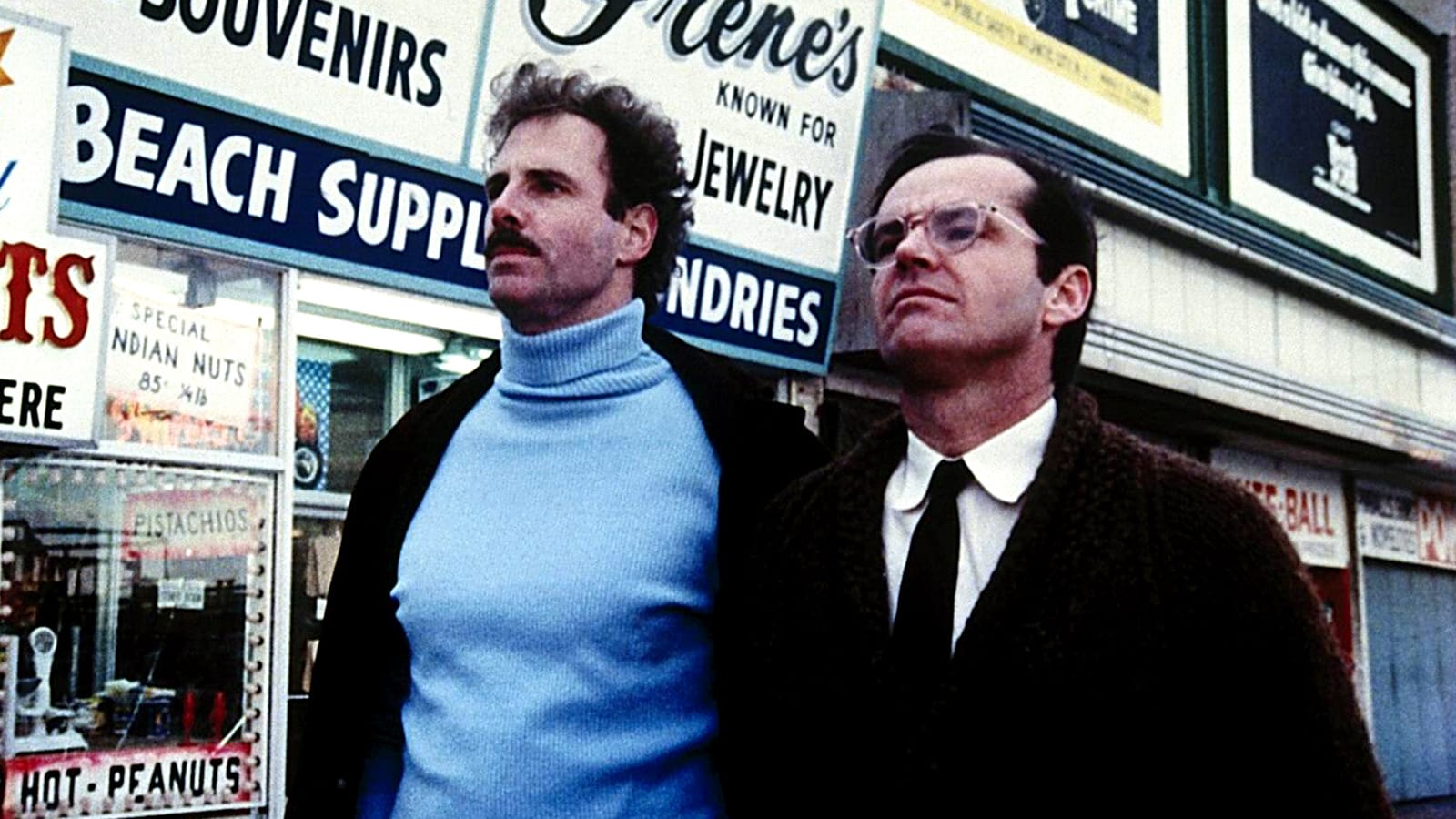
    Secondly, he provided the opportunity for Jack Nicholson to fully emerge from the drive-in movie world (“Easy Rider” had offered a glimpse) and become the standard-bearer of a new kind of movie leading man; a rebel who was fighting himself and society to understand what it was all about.

    And, with “Five Easy Pieces” (1970) and “The King of Marvin Gardens” (1972), Rafelson became a crucial architect of a New Wave of American cinema, which undercut the studio system’s way of making movies and introduced themes, characters, attitudes and language that rarely made appearances in films during the previous four decades.   

    Though this iconoclast was never able to reach the heights he touched with the two Nicholson movies, all his features were interesting, the best of the rest being a sizzling remake of the film noir classic “The Postman Always Rings Twice” (1981), with Nicholson and Jessica Lange; “Mountains of the Moon” (1990), his sweeping telling of the Burton-Speke expedition to find the source of the Nile; and “Blood and Wine” (1996) in which Nicholson and Michael Caine play jewel thieves. His last picture, the barely released “No Good Deed” was another crime film, starring Samuel L. Jackson and based on a Dashiell Hammett story.

     While “Five Easy Pieces” is his masterpiece, among the 50 greatest American films, his less well-known “Marvin Gardens” is essential viewing, one of the best depictions of the love-hate relationship between brothers.


    Rafelson opens the film, before the credits, as few would dare, with a full-screen closeup of Nicholson in a dark room telling a story about himself and his brother when they were kids. It continues for close to five minutes as he calmly remembers the death of his grandfather as the two boys look on. They became “accomplices forever.” When a red light starts flashing on the side of Nicholson’s face, it’s clear that he’s on the radio, finishing up his 3 a.m. show.

    The original title of the script by Jacob Brackman, an Esquire movie reviewer, from Rafelson’s idea, was “The Philosopher King”—the role Nicholson’s sullen, thoughtful David Staebler plays in this morality tale opposite his fast-talking con-man brother Jason (Bruce Dern). It shouldn’t be a surprise, considering that Jason has 70 percent of the dialogue that the actors were original set to play the opposite roles.

      Dern has rarely been better as he schemes to find funding to build a casino on an uninhabited Hawaiian island, but even when David is standing silently in the background it’s always Nicholson’s film. (Though in her key scenes, Ellen Burstyn is just as riveting as Jason’s depressed, aging companion.)

    Set in the Monopoly world of a nearly deserted, off-season Atlantic City—yes, life is just a game for some—this movie sees America as a shell of its former self; a crumbling dream with the dreamers drifting from one grift to another.   

     The film ends with David back on his show “etc.” offering his version of his trip to the Jersey coast (a monologue written by Nicholson) and then returns to his home that he shares with his grandfather, alive and well.

    If Rafelson didn’t live up to early expectations, you certainly can see his influence in the works of some of the best filmmakers of the 1970s: Coppola, Ashby, Pakula, Ritchie. Not a bad legacy.


HONKY TONK (1941)

     All these years, I never made an effort to watch this popular frontier romance, assuming that it recycled the same cliches of the genre. And it does: Shady but good-looking man, fast with the women and his six-shooter, becomes civic minded, helping create a real community out of a Western outpost.

     But the film, despite its meaningless, generic title, offers something more. Though a mainstream commercial product, starting Clark Gable, still the “King of Hollywood,” and the newly crowned glamour girl, 20-year-old Lana Turner, and directed by MGM veteran Jack Conway (who had been directing pictures since De Mille and Griffith relocated to Hollywood), it dares to show what most pro-capitalism American movies ignore. From the very start, America was built on corruption, from newly appointed governors, local judges or struggling shopkeepers everyone was getting their cut of the action. Bribery and illicitly gained profits, taken at the end of a gun or under pressure from powerful officials, were what turned America, at least west of the Mississippi, from a dusty frontier to thriving money-making machine, be it Las Vegas or Dodge City.

    Gable, just two years removed from his signature role as Rhett Butler in “Gone with the Wind,” plays Candy Johnson, who, when the movie starts, is literally about to be tarred and feathered, along with his partner The Sniper (a low-key Chill Wills), for scamming the locals.

     That’s when Candy realizes that there are other ways to con the public. In the ironically named Pleasantville, he finds an old friend (Frank Morgan), who now is a county judge facing trouble for taking public money to maintain his drinking. (I doubt if there is any film made before 1950 that doesn’t feature a falling-down drunk, usually as a comic aside.) And, just arriving from Boston, is the judge’s daughter, Elizabeth (Turner), who quickly becomes the focus of Candy’s charming nature.

     Candy hoodwinks the good citizens into thinking he’s better than the last bunch of crooks by building a church and a school and pushes out a corrupt sheriff, but he keeps getting richer and richer. And even after he marries Elizabeth, he keeps his old flame “Gold Dust” (the quintessential saloon gal Claire Trevor) nearby.

     The key scene takes place in the large dining room at his palatial estate, where Candy serves as host for the state’s governor and other legislators, all happy to look the other way in regards to Johnson’s skimming of the public till as long as they get their cut. They all laugh at the drunken judge who condemns Candy. There in miniature, is the foundation of our country. (While another half of the country prospered on the back of inhumane slave labor.)

     While I’m not trying to make a case for “Honky Tonk” as great film, but one can’t help but admire its undersold, but clear message that systemic corruption was as much a part of the winning of the West as saloons, poker games and main street shootouts.  

     Gable is just about perfect for this role; a slight variation of Rhett Butler and a template for many of the performances he gave for the next 20 years of his short career. As an actor, he wasn’t on the level of contemporaries Fredric March, Gary Cooper, Cary Grant or Spencer Tracy, but he never lost his screen charisma that made him a star by 1931. And, unlike his more talented brethren, he was extraordinary consistent. I recently watched “Call of the Wild” (1935), “Lone Star” (1950), “Soldier of Fortune” (1955) and “It Started in Naples” (1960) and he’s equally fine in each. No matter the quality of the film, Gable seemed to always give his all.

    A director of over 100 films starting in 1912, Conway’s best works include the sound version of “The Unholy Three” (1930), Lon Chaney final film; “Viva Villa! (1934) with Wallace Beery, “A Tale of Two Cities” (1935) and numerous other Gable movies.


MRS. HARRIS GOES TO PARIS (2022)

    This lightweight fairytale-like picture, a well-acted version of the Lifetime movie template, serves as an entertaining vehicle for one of Britain’s finest actresses,  Lesley Manville.

     Rarely in the spotlight, the 66-year-old has been stealing scenes in mostly English movies since the mid-1980s.  In 2020, she was extraordinary as Liam Neeson’s wife, fighting breast cancer, in “Ordinary Love.”

     Her Ada Harris is a World War II widow working as a housekeeper and seamstress in late 1950s London. But once a wealthy client shows her a dress purchased at the famous French fashion house Christian Dior, Ada has stars in her eyes.

     After her financial luck takes a turn (an unexpected veteran’s widow pension, winnings from the dog track and a reward for a good deed), she’s off to Paris to buy her Dior dress.

     The film loses any sense of gritty, post-war reality it had in England when Harris lands in the City of Lights. It grows increasingly silly as she becomes enmeshed with the staff at Dior--match-making, leading a strike by workers and butting heads with the uptight store manager (the great French actress Isabelle Huppert). It’s almost as if the Paris scenes are but Mrs. Harris’ daydream.

     Yet the resourceful acting of Manville keeps the film upright. She’s never less than a salt-of-the-earth, humble working woman of the 1950s.

    She’s been disappearing in roles since she became a regular in Mike Leigh pictures, including “High Hopes” (1988), “Secrets & Lies” (1996) and “Topsy Turvy” (1999). In 2002, Leigh gave her a more substantial part in “All or Nothing”

as Timothy Spall’s wife working through the ennui of a couple’s middle age. It was one of the year’s best performances, but she topped herself in Leigh’s “Another Year” (2010) as Mary, the needy alcoholic who clings to a much happier married couple. The way she cuts to the emotional bone of this sad character’s loneliness is as heartbreakingly real a performance as you are likely to see. The script earned an Oscar nomination for Leigh, but Manville was ignored.

     Finally, in P.T. Anderson’s “Phantom Thread” (2017), as the devoted sister who cleans up after her irresponsible brother’s (Daniel Day-Lewis) messes, she scored an Oscar nomination. The next year, she took on the difficult role of Mary Tyrone in a stage production of Eugene O’Neill’s masterpiece “Long Day’s Journey into Night,” which had a short run in Los Angeles. Both she and Jeremy Irons were nothing less than mesmerizing in the play, the most emotionally draining work of the American theater.

     This year, Manville plays Princess Margaret in the latest season of “The Crown” along with the scheming Marquise de Merteuil in a series version of “Dangerous Liaisons” on Starz.


VENGEANCE (2022)

   Any story that sends a hotshot New York writer to rural West Texas in search of the problem with America risks being damned as elitist as it solicits laughs from the stereotype of poor white Southerners.

     But this movie’s insightful, if wordy, script by star-director B.J. Novak and the sympathetic characters he creates manage to spread the satire evenly.

     Novak plays Ben Manalowitz, who we first meet at a party holding a facile, sexist discussion about women with his buddy John (musician John Mayer). But he’s really there to convince a radio exec Eloise (Issa Rae) that he should do a podcast on the issues that divide America. Then, later that night, on cue, he’s bullied into attending the funeral of a women he barely knew months earlier. Abby had led her family to believe they had a real relationship.

      For the first 30 minutes, “Vengeance” plays like a dumb comedy, with Ben unable to express himself and the dead woman’s family overwhelm him with Southern hospitality and insults. Then brother Ty (Boyd Holbrook) insists that Ben stick around and find out who murdered his sister—she apparently overdosed (law enforcement could care less) after a weekly outdoor party.

      Though Ben thinks Ty is nuts, he sees the dead girl and her conspiracy-following family perfect fodder for his podcast and gets the family to agree to be recorded.

       His investigation leads him to an assorted collection of locals, including smooth-talking record producer Quentin (Ashton Kutcher), who recorded Abby before she travelled to New York to seek fame, but not much clarity.

     The film captures both the good and bad of rural America (you don’t have to be from Texas to know these people) but tries too hard to make Ben equally foolish. Sometimes it’s hard to believe he’s a successful writer.

     This first feature film from Novak, best known as Ryan Howard from the TV show “The Office,” reveals a writer-director interested in ideas—especially the nationwide obsession to be famous (a theme the film shares with “Nope”)—and a willingness to let characters talk at length, a rarity in 21st Century Hollywood films.


THE MIRACLE MAN (1932)

    It’s unusual when a Hollywood picture deals with religious faith, but it was a much safer bet 90 years ago when a large majority of the country were regular church-goers. But this 1932 remake of a silent film goes a step further, presenting a faith healer as legitimate.

     The movie begins with a quartet of pickpockets and small-time hustlers—Doc (Chester Morris), Helen (Sylvia Sidney), Harry (Ned Sparks) and The Frog (John Wray)—slipping away from New York cops and regrouping in a small upstate town where Doc finds a philosophical religious man called “The Patriarch.”  

      Doc quickly sets up the scam: Helen arrives in town claiming to be the Patriarch’s long-lost niece, while the Frog, who fakes being a paraplegic, crawling across streets and floors, shows up to be “cured.” Once the word gets out, Doc and Helen plan to rake in donations from all over the country. The plan looks like a sure thing as the Patriarch, played by silent film director Hobart Bosworth, seems to be in a constant stupor.

     But things take a strange turn when the Patriarch actually does heal people, including a crippled local boy and a society woman. Oddly, there’s no long line of people seeking cures—apparently the filmmakers decided that would muck up the story, which, surprisingly, comes from a stage play by legendary song-and-dance man George M. Cohan. Director Norman Z. McLeod, best known for Marx Brothers and W.C. Field comedies, doesn’t bring much to the film, lingering over closeups of star Morris, waiting, it seems, for some sign of acting to kick in.   

      As usual, Sidney, one of the finest actresses of early sound, is completely convincing as she struggles with her role in the scam. In 1931 alone, she starring in Rouben Mamoulian’s “City Streets,” Josef von Sternberg’s “An American Tragedy” (from Theodore Dreiser’s novel) and King Vidor’s “Street Scenes.” Later in the 1930s, she headlined Fritz Lang’s “Fury” and “You Only Live Once,” William Wyler’s “Dead End” and Alfred Hitchcock’s “Sabotage.” Though few actors have ever worked with so many great filmmakers in a single decade, she fell out of favor in the 1940s—when she was still in her 30s—and then turned to TV in the 1950s.

     In 1973, she scored a supporting actress Oscar nomination playing Joanne Woodward’s mother in “Summer Wishes, Winter Dreams” and continued to work steadily until 1996—her last film was as the grandma in “Mars Attacks!”

      The 1919 original “Miracle Man,” a lost film, is most famous for Lon Chaney’s ability to distort his limbs as The Frog. John Wray, who played the drill sergeant in “All Quiet on the Western Front,” does a good job following the master of offbeat characters.


 PHOTOS:

Jean-Luc Godard

Daniel Kaluuya in "Nope"  (Universal Pictures)

Bruce Dern and Jack Nicholson in "The King of Marvin Gardens" (Columbia Pictures)

Clark Gable and Lana Turner in "Honky Tonk"  (MGM)